






Our data in the hands of strangers immediately raises concerns: privacy, consent, control, access, costs. We take Nomination #3 for the MHF 2026 Defender Award from just such a question, asked in committee hearing where it counts.
Many will recall that Governor Whitmer called for live, real-time access to patient health information during state COVID tracking in 2020.
Michigan took a big step toward that goal when the House Health Policy Committee heard House Bills 4037 and 4038 on March 12, 2025.
Health Data transmission
Health data transmission is confusing, partly on purpose. What you don’t know can hurt you, so here goes the simple explanation.
Remember how Obamacare promised “interoperability”? Meaning your health records would be available wherever needed – doctor’s office, emergency room, on vacation, wherever you needed surgery.
One problem. Billions of dollars and dozens of mandates later, interoperability still hasn’t happened.
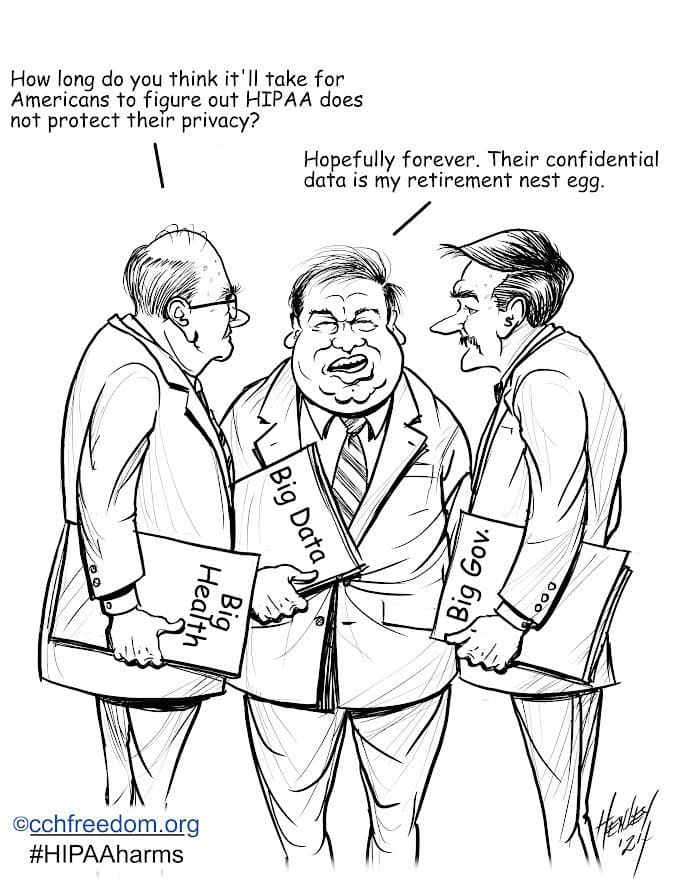
So here we are at this bill hearing, because health data means big money and control; and Big Tech, Big Health, and Big Government haven’t given up trying to hook all the parts together.
- HIE = Health Information Exchange
- HDU = Health Data Utility
Michigan has an HIE, and some people want an HDU.
As written, the HDU “combines and facilitates the exchange of disparate clinical and other health data for treatment, care coordination, quality improvement, population health, public health emergencies, and other public health and community health purposes.” (House Fiscal Agency analysis)
- HIPAA = the federal Health Information Portability and Accountability Act
The HIE/ data center testimony is that privacy is protected because they have to follow HIPAA, and because HIPAA is incorporated into their legal agreements with “trusted data sharing organizations.”
Representative Matthew Bierlein asks what most of us are afraid to know. It earns him the 3rd nomination for the MHF 2026 Defender Award.
“Define trusted data sharing organization.”
Rep. Bierlein is right to be concerned about who has access to patient records. You should be, too.
“Who gets access to patient information” is not really defined here. It’s “whoever signs the legal agreement.” That’s only a paper barrier, and it’s not worth much.
Massive access to our health data happens all the time, nonstop; although in this case they say that access is by invitation only.
This is all perfectly legal under HIPAA.
What you didn’t know about HIPAA
A marketing miracle happened when the US Congress passed HIPAA. Someone called it The Privacy Law, and the name stuck. Unfortunately, the name happens to be a lie, with lots of other lies built in.
Top three facts from the short version:
- Under HIPAA, electronic transfer of patient health information is allowed to 2.2 million entities in the arena of healthcare, government, insurance, research, and more.
- Most patients don’t know that signing HIPAA forms gives central planners access to their data.
- People have no idea that they may refuse to sign.
The sprawling longer version.
HB 4037-8 passed the Michigan House Health Policy Committee and awaits action in the House.
Previously published for the MHF 2026 Defender Award: Nominee #1 and Nominee #2.
Cartoon image credit: Citizens Council for Health Freedom.