- Corewell Health posts 1.6% operating margin, grows revenue to $17.6B — 7 things to know

- Hasta los pacientes se sorprenden por los precios que sus aseguradoras están dispuestas a pagar, un costo que al final pagamos todos

- Cooper University Health Care Selects hellocare.ai as Enterprise Platform for AI-Assisted Intelligent Hospital Rooms, Virtual Nursing, and Virtual Sitting

- How to Get Ready For Daylight Saving Time
- A-Fib Drug Could Interact With Blood Thinners, Increase Risk Of Dangerous Bleeding
- Collagen Supplements Good For Skin, Arthritis, Evidence Review Concludes
- Effective Sunscreen Protection Can Cost $40 A Year
- Illicit Adderall Use Places Stress On The Heart, Study Shows
- Breast Cancer Cases, Deaths Expected To Rise Worldwide
- Federal Aid for Lead Cleanup Is Receding. That’s a Problem for Cash-Strapped Cities.

- Readers Lean On Congress To Solve Crises in Research and Rehab

- Even Patients Are Shocked by the Prices Their Insurers Will Pay — And It Costs All of Us
- Esperion pays $75M-plus to acquire Corstasis and newly approved Enbumyst
- The dental workforce trends that will dominate 2026
- Federal Medicaid cuts threaten dental care access: See the potential impact by state
- Children’s Mercy raises $150M for mental healthcare
- California awards $291M to expand behavioral health housing, services
- Think bigger – Turning AI from Trends to Long-Term Transformation
- UnityPoint Health hospital names market chief nursing officer
- OhioHealth builds well-being programs to reshape caregiver culture
- Washington hospital staff vote ‘no confidence’ in management company
- U of Mississippi Medical Center restores phone lines after cyberattack
- 13 health system IT leadership moves
- How health systems are repositioning informatics
- Mississippi hospital names COO
- Ex-Amazon Health leader joins Spotify founder’s health tech startup
- Know the True Value of Your Lab When an Offer Is on the Table
- UF Health taps new outpatient senior VP
- UAMS names new director of cardiovascular medicine division
- CMS’ add-on billing code boosts specialist pay: Study
- Lawmakers introduce bill to reverse Medicaid cuts, expand Medicare benefits
- Florida medical center to expand with ASC
- New Jersey woman charged with practicing unlicensed dentistry
- CMS extends hospital-at-home waivers for 5 years: What ASCs need to know
- 100+ organizations call on CMS to revise 2027 MA rates
- The retention breakthrough anesthesia needs
- Oklahoma advances interstate compact bill
- Brown University Health names new chief of cardiac surgery
- UNC Health Appalachian offers psychiatric physician training program
- Former PepperPointe Partnerships COO joins DPO
- The Smilist expands into Virginia
- Physician-led orthopedic ASC opens in Florida
- Colorado Medicaid ABA audit finds $77.8M in improper payments
- Georgia opens 30-bed forensic mental health unit to ease jail backlog
- Pennsylvania county cuts ribbon on $19.8M mental health diversion center
- Outpatient cardiology’s CMS whiplash
- 12 new ASCs in February
- UHS to roll out behavioral health revenue cycle AI tools in 2026
- UHS to roll out behavioral health revenue cycle AI tools in 2026
- In 1 state, large hospitals dominate 340B's net savings
- 15 dentists making headlines
- CMS to suspend enrollment into Elevance’s Medicare Advantage plans
- Report: Most states investing in value-based care with Rural Health Transformation Program
- U.S. Tops 1,100 Measles Cases This Year as Outbreaks Grow
- FDA To Offer Cash Bonuses for Faster Drug Reviews
- 10 providers seeking RCM talent
- PDS Health added de novos across 3 states in February
- Novant posts 4.8% operating margin in 2025
- 'One2PrEP': Gilead's 1st Yeztugo DTC ad reimagines hit song to highlight biannual dosing
- Cleveland Clinic posts $913M operating income, 5% margin — 7 things to know
- GLP-1s support heart attack recovery in rodents by relaxing tight blood vessels
- Former Optum CEO Heather Cianfrocco to depart UnitedHealth Group
- New Drug, Acoziborole, Could Boost Efforts to Wipe Out Sleeping Sickness
- Chocolate Male Supplement Recalled Over Hidden Erectile Dysfunction Drug
- Your Anesthesia Subsidy: Key Questions Every Hospital C-Suite Must Answer
- Clinician Engagement: The Operating Lever Behind Margin and Throughput
- Amid unfolding Middle East war, pharma giants keep close eye on employee safety, supply chains
- CMS set to suspend enrollment in Elevance Health's Medicare Advantage plans
- Providers urge Education Department to reconsider which jobs face stiffer student loan caps
- Kennedy adds 2 new members to CDC’s vaccine panel ahead of delayed meeting
- Kennedy adds 2 new members to CDC’s vaccine panel ahead of delayed meeting
- Urban Traffic Noise Disrupts Sleep, Affects Heart Health After One Night
- Hormone Therapy Might Be Unnecessary For Some Prostate Cancer Patients
- Benzodiazepine Use Down In U.S., But OD Risk Remains, Study Says
- GLP-1 Drugs Might Ease Chronic Migraine, Study Says
- Blood Test Reveals Alcohol-Related Liver Disease
- Telemedicine Visits Cost Five Times Less Than In-Clinic Care
- Families Defend Disability Services Amid Medicaid Cuts

- Medicaid Is Paying for More Dental Care. GOP Cuts Threaten To Reverse the Trend.

- Bavarian Nordic CEO to follow board chair out the door after failed private equity takeover
- Ascendis gains more altitude with FDA approval for dwarfism drug Yuviwel
- CDMO Quotient extends Ipsen supply pact for rare disease drug Sohonos
- Quest Diagnostics launches Google-powered AI chatbot to help patients understand lab results
- Tennr takes aim at phone call bottlenecks as it builds out automation for patient referral process
- DoseSpot, Arrive Health merge to combine prescribing tools with pharmacy, medical benefit data
- Why Digital Tool are Needed to Cope with Increasing Pressures in MedTech Innovation

- Why Digital Tool are Needed to Cope with Increasing Pressures in MedTech Innovation
- Electronics Pollution Pose Added Threat to Endangered Dolphins, Porpoises
- Flea And Tick Pills May Pose Environmental Risks, Study Finds
- ICE, ALS, Addiction Medicine, and Robotic Ultrasounds: Journalists Sound Off on All That and More

- 11 behavioral health executive moves to know
- 3 behavioral healthcare M&A deals in 2026
- Iowa dentist surrenders license
- Temple University gets approval for $3.19M rural dental clinic
- A Canadian Hospital Scoops Up Nurses Who No Longer Feel Safe in Trump’s America

- Statement on the Adoption of Final Rules Under the Holding Foreign Insiders Accountable Act
- Statement on Final Rules for the Holding Foreign Insiders Accountable Act
- State Medicaid budgets to weather $664B reduction through 2034 due to OBBBA: RAND
- Clover Health CEO said company sees opportunity in complex MA environment
- How pharma marketers are capturing the power of podcasts to connect with consumers
- Cigna's Evernorth quietly acquires hospital pharmacy CarepathRx
- Walgreens debuts virtual weight management clinic with access to GLP-1 meds
- New Obamacare Rules Could Raise Deductibles to $31K For Families
- Study Suggests One Common Amino Acid May Affect How Long Men Live
- Merck to wind down Gardasil production at N.C. plant, lay off 150-plus
- Walmart Great Value Cottage Cheese Recalled Over Pasteurization Issue
- Chris Bosh Says He’s 'Lucky To Be Alive' After Sudden Health Scare
- Patrick Kennedy: Collab with MAHA is essential to address mental health crisis
- Lilly debuts Nvidia supercomputer with fanfare and focus on escaping traditional pharma lifecycle
- Alignment CEO John Kao offers measured response to proposed 2027 MA rates
- Sanofi, Genentech, Kedrion back star-studded bleeding disorder awareness campaign
- Op-ed: Our patients deserve better safety reporting. AI could be the answer
- After CHMP nod, Moderna CEO applauds EU's 'rigorous scientific review'
- UCB's fast-growing Bimzelx leaps across blockbuster sales threshold as HS momentum builds
- Blood Test Can Predict Short-Term Survival Among Seniors
- How the Brain Learns to Have Seizures During Sleep
- Why Turning 19 Spikes Medicaid Loss for Millions
- Crash Course Might Speed Brain Stimulation Treatment For Depression, Study Suggests
- Wildfire Smoke Linked To Increase In Violent Assaults
- More Parents Are Refusing A Life-Saving Shot For Their Newborns, Study Finds
- To Avoid Care Disruptions, Know When the Clock Runs Out on Your Prior Authorization
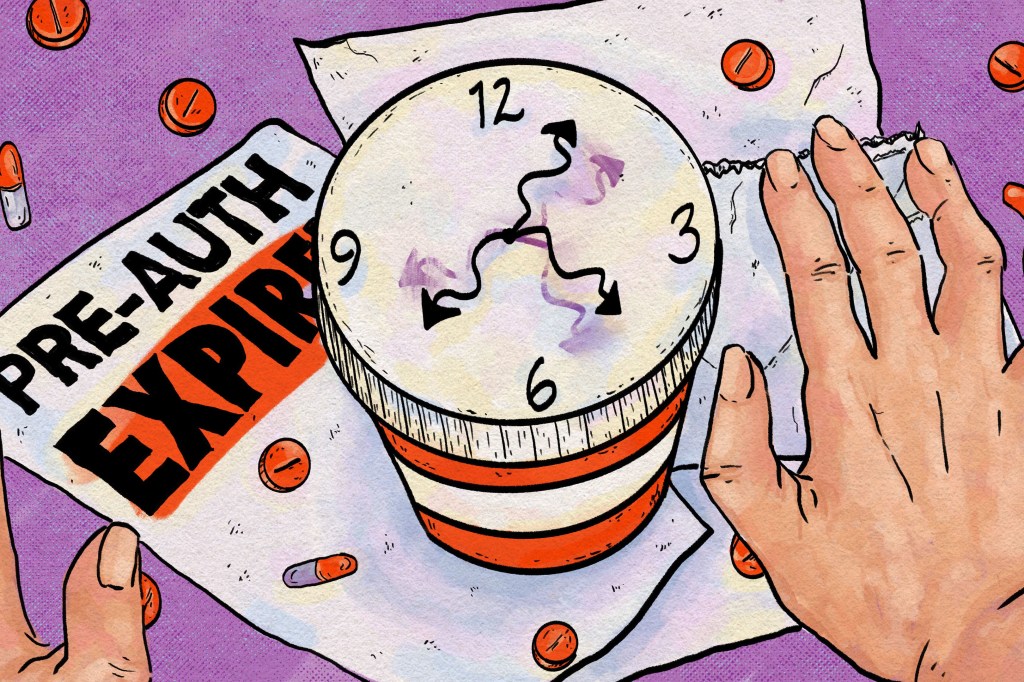
- He Needs an Expensive Drug. A Copay Card Helped — Until It Didn’t.

- As SCOTUS takes on 'skinny label' review, top US lawyer sides with generics maker
- Lake Nona Impact Forum: There can't be longevity without tech
- Fierce Pharma Asia—China deal growth; Daiichi's new CMO; Astellas-Vir bispecific tie-up
- Autoimmune CAR-T: Navigating the FDA’s new regulatory playbook
- FDA Approval for BIOTRONIK Solia CSP S Pacing Lead For LBBAP

- FDA Approval for BIOTRONIK Solia CSP S Pacing Lead For LBBAP
- Catalyst OrthoScience gets FDA 510(k) Clearance of Archer® Patient-Specific Instrumentation for Shoulder Arthroplasty
- Catalyst OrthoScience gets FDA 510(k) Clearance of Archer® Patient-Specific Instrumentation for Shoulder Arthroplasty
- Smith+Nephew signs distribution agreement with SI-BONE
- Smith+Nephew signs distribution agreement with SI-BONE
- Quantum Surgical Acquires NeuWave Medical, Inc.
- Quantum Surgical Acquires NeuWave Medical, Inc.
- How Pharma is Expanding its Global Footprint to Advance Clinical Research
- Partnering to Advance Drug Delivery Innovation
- Teladoc Health reports slower growth, offers cautious 2026 outlook as it shifts telehealth model
- CFO Mark Kaye to take the helm at Carelon in leadership shake-up at Elevance Health
- Insurance groups say proposed flat Medicare Advantage rates fail to meet the moment
- Health Gorilla urges court to toss lawsuit filed by Epic, health systems
- Stryker launches Synchfix™ EVT, expanding options for flexible syndesmotic fixation
- Stryker launches Synchfix™ EVT, expanding options for flexible syndesmotic fixation
- Democrat-Led States Sue Trump Administration Over Cuts to Childhood Vaccine Schedule
- CDC Vaccine Advisory Panel To Revisit COVID Shot Safety Next Month
- Frozen Blueberry Recall Issued Across Four States for Listeria
- After delay, CDC vaccine panel sets new dates to discuss long COVID and mRNA shot safety
- Decision Criteria for Technology Commercialization of Medical Devices in 2026
- Decision Criteria for Technology Commercialization of Medical Devices in 2026
- Continuous Cardiac Monitoring: Redefining the “End” of a Clinical Study?
- Continuous Cardiac Monitoring: Redefining the “End” of a Clinical Study?


Senators Hertel and Santana (both Democrats) have introduced tie-barred Senate Bills SB 790 Home Help Caregiver Council Act and SB 791 (untitled) to subsidize the Service Employees International Union (SEIU) with a raid on the meager earnings of Michigan home health care workers. This payoff to the Senators' masters at SEIU will come just in the nick of time to backfill the SEIU treasury, after they spend the promised $ 200 million to re-elect President Joe Biden this year.
These two brave defenders of democracy are deviously subverting the will of the people of Michigan, who defeated Proposal 2012-04; a constitutional amendment which would have mandated dues skimming had it passed:
Michigan Senate bills would revive dues skim for home health workers
Government employees can opt out of unions, but Senate Bill 790 would make it much harder
By James David Dickson | March 16, 2024Share on FacebookShare on XState Sen. Kevin Hertel, D-St. Clair Shores, has sponsored a bill that would revive a “dues skim” in Michigan. (Screenshot: Michigan Senate TV)
If you’re not familiar with the phrase “dues skim,” that’s because it was a battle fought and won more than a decade ago.
Years before dues skim went away, home health workers — often people taking care of loved ones who cannot take care of themselves — would realize that their paychecks were light.
Then they found out why: They were paying a union they never signed up for or received benefits from. Dues were being skimmed from their paychecks, and nobody even bothered to ask. That practice was put to rest in 2013.
But the old days of dues skim would return under Senate Bill 790, which was submitted Thursday by Sen. Kevin Hertel, D-St. Clair Shores.
Officially, the 15-page bill says it would create the Home Health Caregiver Council, a seven-member board that would oversee issues involving those workers. The council would set compensation rates and issue checks for home health workers.
It would also be authorized to deduct union fees. Under the previous iteration of dues skim, the Service Employees International Union pulled in about $34 million between November 2006 and February 2013.
The dues skim ended in March 2013, when the SEIU’s contract expired.
“The checks mailed in March are expected to be the last ones from which union dues will be deducted,” CapCon reported back then.
The same day Hertel submitted Senate Bill 790, the SEIU announced plans to spend $200 million to r-elect President Joe Biden.
The new scheme would make opt-outs onerous. Thanks to the 2018 U.S. Supreme Court decision Janus v. AFSCME, government employees have a First Amendment right to opt out of unions. But Senate Bill 790 is not written to make opt-outs easy.
The home health worker who wanted to leave the union would have to ask the union, not the newly created state council. And the union, not the council, would be the one to process the cancellation.
“The council shall rely on information provided by the bargaining representative regarding whether deductions for a labor organization were properly canceled or changed, and the labor organization shall indemnify the council for any claims made by the individual home help caregiver for deductions made in reliance on that information,” reads a portion of the bill.
Senate Bill 790 is tie-barred with Senate Bill 791. That means both must be enacted into law for either to take effect.
Senate Bill 791 changes a law in Michigan that removes caregivers from the definition of “public employee.” That law was enacted in response to the dues skim of the past.
In November 2012, the people of Michigan rejected Proposal 4 of 2012. According to Ballotpedia, the people of Michigan rejected Proposal 4 by a 56-44 margin. The proposal would have allowed in-home care workers to collectively bargain.

MichCapCon lays out more of the big picture here: it's definitely about the money.
Thank goodness for watchdog organizations!
If the graphs don't make it into the post, it's worth your while to check them out in the link.
Michigan’s largest unions have seen plummeting membership over the past decade
Jobs and incomes are up, workplace injuries are down
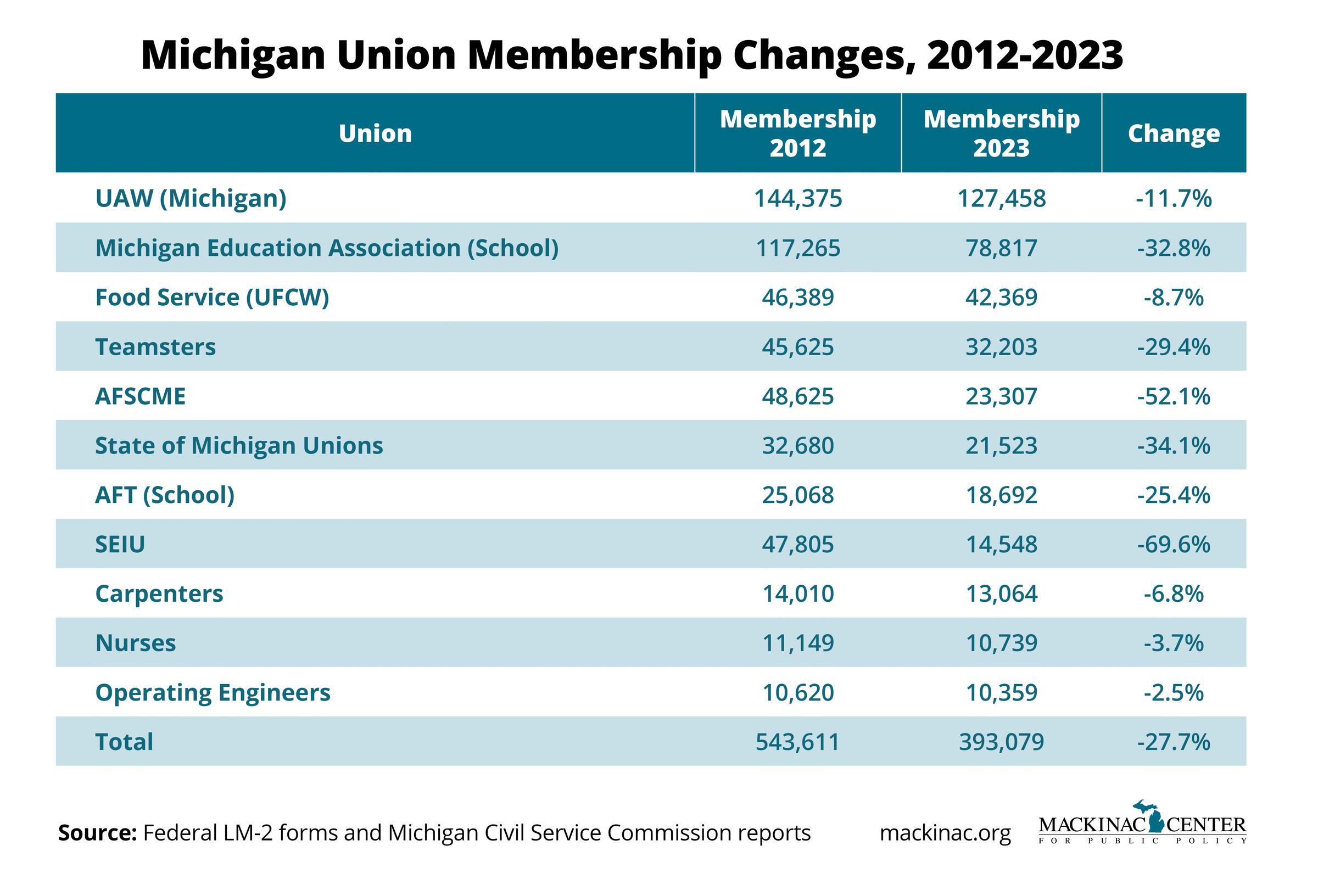
In recent years, most of Michigan’s largest labor unions saw massive declines in membership, despite significant job growth in most industries. The reason? A decade with right-to-work law, which gave workers the ability to choose whether to join a union, as a member or through a fee, or not.
The reports many labor unions are required to file with the federal government reveal the state of labor union membership, as do reports from the Michigan Civil Service Commission. Every one of Michigan’s 15 largest unions or so has seen a decline, whether in state government, schools, local government, or private industries such as construction or food service. But the declines are uneven. A variety of AFSCME associations, representing mostly state and local government workers, have seen a loss of more than half their members. The SEIU, which mostly represents workers in health care and local government, is down nearly 70%.
Despite job gains in the auto sector over the past decade and a highly publicized strike last year, the UAW branches in Michigan have lost 16,000 members over the past decade. Other private sector unions have seen fewer losses. These include the United Food and Commercial Workers (-8.7%), Michigan Regional Council of Carpenters (-6.8%), the Operating Engineers (-2.5%) and Michigan Nurses Association (-3.7%).
Losses in the public sector are much more pronounced than those in the private sector. The Michigan Education Association has now lost more than 38,000 members, or one-third, since the right-to-work law went into effect in 2013. The American Federation of Teachers branch, the bulk of which is in the Detroit Federation of Teachers, is down more than 25%. The Michigan public school system added 27,000 employees since 2012, but its largest employee unions have lost a combined 45,000 members.
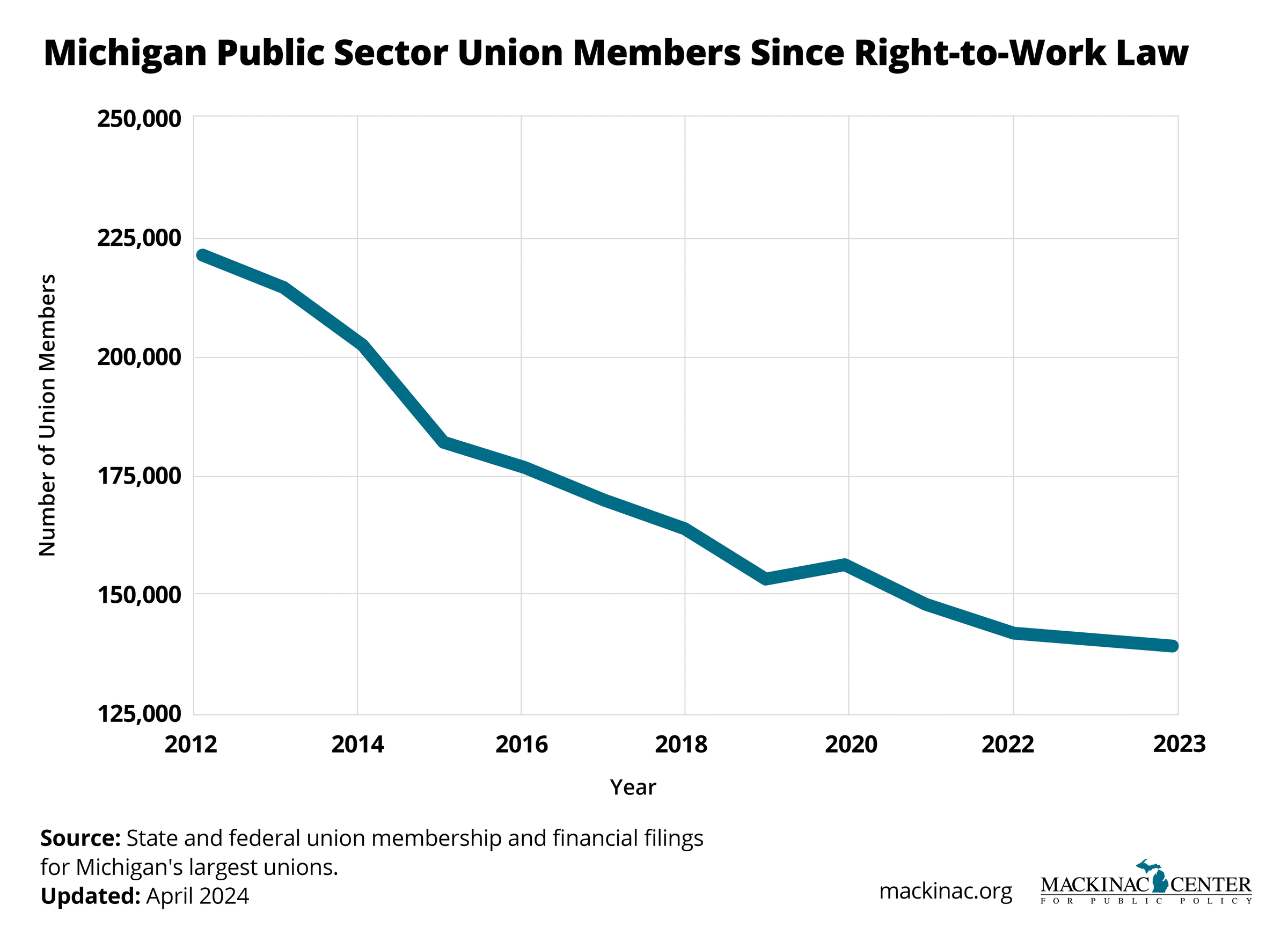
The total number of public sector union members in Michigan has dropped by 80,000 since the right-to-work law was passed. Unions representing state of Michigan employees are down by more than one-third.
That may soon change. The Democratic-led Michigan Legislature repealed the state’s right-to-work law in 2023. The UAW and other unions representing workers for private employers can now require them to rejoin or pay fees. A 2018 ruling from the U.S. Supreme Court means that public sector employees such as schoolteachers still have the right to decline paying or joining a union.
Repealing the law is expected to boost union membership and financial support for the Democratic Party. In fighting in 2012 against a law allowing workers to opt out, SEIU Healthcare Michigan President Marge Faville said unions needed the forced funds to “make sure Democrats get [elected].” Just before legislators voted to enact a right-to-work law, a local Michigan Education Association leader sent an email out on a public server to tell other public school employees that “[emergency management] is the future in Michigan with a Republican governor and Legislature” and union members need to “[get] everyone we know to vote for Democrats.”
In the run-up to the law, opponents of right-to-work claimed there would be dire consequences. President Barack Obama predicted there would be fewer jobs and lower incomes, as did Gov. Gretchen Whitmer (then a state senator) and others. State Rep. Brandon Dillon said “workplace safety accidents” would “skyrocket.” UAW President Bob King said right-to-work would “destroy ... the middle class.”
None of these predictions bore out. From 2012 to 2022, Michigan incomes increased from $55,140 to $61,683, despite the COVID recession — an increase of more than $6,000 per year after inflation. Median household income went from $45,859 to $63,498, or 15% above inflation. Michigan added 382,000 jobs. Occupational injuries declined by 28%.
At the end of June before summer break, this bill package passed the senate with a floor vote of 20-18.
Michigan Capitol Confidential reports on the details.
Bills aim to return Michigan to bad old days of dues skim
Voters soundly rejected this shady union funding practice in 2012
Michigan home health care workers might have to go back to giving up part of their paychecks to a union if two bills passed by the state Senate become law.
Senate bills 790 and 791 aim to revive the dues skim, in which a union takes money from Michigan home health care workers, most of whom are private people who get small public reimbursements for caring for elderly or disabled family members.
From 2004 to 2013, Care Council legislation created a fictional employment relationship between home health care providers and the state, allowing the Service Employees International Union to take millions of dollars from federal stipends. The practice was never popular with Michigan home health care providers, with only 20% voting for unionization in 2005. Over nine years, dues skimmed just from Medicaid checks totaled more than $31 million.
The practice came to an end after the Mackinac Center brought the practice to wide public attention. The Legislature defunded the Care Council in 2011. The SEIU tried to continue the skim by funding the council for another two years, allowing the union to collect an additional $12 million. But Michigan voters roundly rejected the practice when unions put the issue on the ballot as Proposition 4 of 2012.
Organized labor outspent opposition by a factor of more than four to one, putting almost $16.5 million into the ballot initiative. But voters rejected Prop 4 in a 57-43% vote, and dues skim came to an end in 2013.
But the bills passed by the Senate would reinstate this practice.
Sen. Kevin Hertel, D-St. Clair Shores, rallied with the SEIU at the state Capitol after the vote.
“The Senate just passed legislation that will help us build a home care system that works for everyone — a system where every family can access quality care and where caregivers no longer have to lay awake at night worrying about how to make ends meet,” Hertel posted on social media.
The union has donated to Hertel’s campaign and those of Michigan’s top three elected officials.
In 2022, the Michigan State SEIU Council donated $21,000 to Hertel’s campaign. Gov. Gretchen Whitmer has received over $107,000. Secretary of State Jocelyn Benson and Attorney General Dana Nessel each received $71,500 in 2022.
In 2008, SEIU spent $85 million to support the presidential campaign of Barack Obama. This year, SEIU has promised $200 million to President Joe Biden and other Democratic campaigns.
The Legislature sets stipends for home care providers, and spending on home health services has skyrocketed recently, rising by 38.1% from 2012-13 to 2023-24.
Michigan lawmakers could have given home health care providers a raise without enacting a mandatory union, said Patrick Wright, the vice president for legal affairs at the Mackinac Center.
“The legislators had and used the ability to give home help providers raises and extra appropriations without a mandatory union,” Wright said in a statement. “All a union will allow is for millions to tens of millions to be skimmed for union officials and politicians.”
Gov. Gretchen Whitmer’s office did not respond to a request for comment.
Governor Whitmer took time out of her busy anti Catholic video taping schedule to sign Michigan SB 790 & SB 791 into law. SEIU will now steal a percentage of home health care workers meager pay under the guise of "protecting workers’ rights":
Gov. Whitmer Signs Bills to Protect Home Care Workers’ Rights, Expand Access to Healthcare in Rural Michigan, and More
October 08, 2024
Gov. Whitmer Signs Bills to Protect Home Care Workers’ Rights, Expand Access to Healthcare in Rural Michigan, and MoreLANSING, Mich. -- Today, Governor Whitmer signed 17 bills into law. These bills bolster Governor Whitmer’s commitment to making Michigan the best place to live, work, and invest by ensuring our Michiganders have the support they need to thrive whether they’re going to work or accessing healthcare. These bills work to increase access to vital services and put more money back in Michiganders’ pockets.
“These bills will make a real difference in people’s lives by expanding access to healthcare, protecting workers’ rights, and putting money back in Michiganders’ pockets,” said Governor Whitmer. “From ensuring 35,000 home care workers can bargain for better pay and benefits to ensuring every Michigander can access quality healthcare regardless of their zip code, let’s keep working together to make sure that everyone can make it in Michigan.”
Senate Bill 790 and 791, sponsored by state Senators Kevin Hertel (D-St. Clair Shores) and Sylvia A. Santana (D-Detroit) allows individual homehelp caregivers in Michigan to unionize. These bills will support workforce development, expand training, and restore bargaining rights for 35,000 home care workers in Michigan.
“From automotive factories to the food service industry, we’ve seen that workers can negotiate for better wages and working conditions when they’reunited together as one. Individual homecare workers deserve nothing less than the ability to collectively bargain just as workers in all other sectors have,” said state Senator Kevin Hertel. “With this legislation, we are ensuring these essential workers have the tools they need to secure higher wages, better benefits, and pathways for professional development. They’ve been there for our families when we’ve needed them most; this is our opportunity to be there for them.”
“With the signing of Senate Bill 791 and its companion SB 790, we’re providing essential support to our homecare workers. These caregivers are a vital part of the safety net for our most vulnerable residents, and their contributions to our communities cannot be overstated,” said state Senator Sylvia Santana. “Thank you to the Governor and my colleagues in the Legislature for helping deliver such crucial support to our caregivers.”
Senate Bill 701, sponsored by state Senator Sam Singh (D-East Lansing) supports health care access in rural Michigan by amending restrictions on the funding Michigan hospitals can receive. The bill eliminates the definition of “critical access hospital” and modifies the definition of “rural hospital.” It also raises the population limit to be considered a “rural hospital” to include counties with 195,000 people or less, adding Livingston, Muskegon, and Saginaw counties to the rural hospital pool.
“It is critical that we ensure our rural hospitals have the funding and resources they need to provide quality care to the communities that rely on them,” said state Senator Sam Singh. “The legislation signed by Gov. Whitmer today ensures equitable funding for Memorial Healthcare and the many other hospitals across our state serving rural communities.”....
Get MHF Insights
News and tips for your healthcare freedom.
We never spam you. One-step unsubscribe.
Sponsors
Friends of MHF





Kirsten DeVries
Tom & Karen Nunheimer
Steve Ahonen
Ron & Faith Bosserman
Marlin & Kathy Klumpp
Sign Up for MHF Insights to keep up on the latest in Michigan Health Policy