













Michigan healthcare freedom community forum

Mobile Phlebotomy of Central Michigan filed a lawsuit in Saginaw County Circuit Court against Covenant HealthCare and phlebotomist Kaleigh Sobanski. The suit states that Sobanski signed a noncompete clause with MPCM, but later went to work for Covenant in violation of the noncompete agreement. MPCM was under contract to Covenant to provide phlebotomists.
Lawsuit alleges Covenant HealthCare poached phlebotomists with non-compete contracts
By Cole Waterman | October 6, 2023SAGINAW, MI — A Saginaw hospital has been targeted by a lawsuit for allegedly poaching phlebotomists. Also named as a defendant is a woman alleged to have violated a non-compete contract that prohibited her from working as a phlebotomist for the institution.
In her attorney’s eyes, the move is punitive, and the five-year noncompete clause is ultimately unenforceable.
Through attorney Errick A. Miles, Mobile Phlebotomy of Central Michigan on Aug. 7 filed its lawsuit in Saginaw County Circuit Court against Covenant HealthCare and phlebotomist Kaleigh Sobanski. The suit states MPCM is a staffing contractor that facilitates phlebotomists getting work in hospitals and health care facilities.
Sobanski was one such worker who signed a noncompete clause with MPCM, the suit states. MPCM was contracted through Covenant to provide them with trained and qualified phlebotomists.
“Contrary to state and federal law, Covenant has been intentionally and deliberately encouraging, aiding and causing MPCM’s contractors to breach their agreements with MPCM and then hiring those individuals as phlebotomy employees,” the suit alleges.
Covenant “surreptitiously poached” Sobanski from MPCM, causing her to breach her contract, the suit alleges.
“My clients were working with Covenant and would provide them staff because they didn’t have any in-house (phlebotomists),” Miles told MLive. “At some point, Covenant determined they wanted to do the service in-house and started poaching my client’s workers.”
As exhibits, Miles included affidavits from two phlebotomists under contract with MPCM. Both stated Covenant staff approached them on several occasions to see if they wanted to work directly for them. The phlebotomists alleged Covenant staff had already told them they hired Sobanski and that her interview was held in Bay City “so that no one from MPCM would find out about it.”
Both wrote Covenant was aware of their non-compete contracts.
“The staff person then advised if Kaleigh could get away with (breaching contract), then anyone could, and the staff person then asked me if I would join them,” one phlebotomist wrote. “I again declined.”
The suit contains the following eight counts:
· Tortious interference with contract against Covenant
· Tortious interference with business relationship and/or expectancy against Covenant
· Breach of contract against Covenant
· Breach of contract against Sobanski
· Tortious interference with contract against Sobanski
· Tortious interference with business relationship and/or expectancy against Sobanski
· Antitrust violations against Covenant
· Conspiracy against both defendants
In the coming weeks, Miles said he plans to file an amended complaint with a second phlebotomist added as a defendant.
Sobanski and the other phlebotomist have retained Bay County attorney Stephan A. Gaus to represent them. In his Aug. 28 response to the suit, Gaus wrote Sobanski, a mother of three who lives in Hope, was terminated by MPCM before being hired by Covenant. While he conceded Sobanski signed a document with MPCM, he wrote it was not a binding contract. He also wrote that Covenant did not “poach” Sobanski.
Speaking with MLive, Gaus said the contract in question prohibits one from working as phlebotomist anywhere in Michigan for five years after termination. This, he maintains, violates a Michigan statute that states non-compete clauses must be “reasonable as to its duration, geographical area, and the type of employment or line of business.”
MPCM terminated Sobanski in June when she declined to sign a new non-compete contract that would serve as a “patch to a loophole,” Gaus said. The new contract would prohibit former MPCM phlebotomists from working for specific Michigan hospitals, Covenant among them, for two years, he added.
Gaus’ other client also refused to sign the new contract, was fired, and then hired by Covenant, he said.
“It has all of the earmarks of a vendetta,” Gaus said of the suit. “I’m advised others did this before and nobody else got sued. It is utterly unenforceable. Now, it’s just whether they can cause this young family a lot of turmoil in going through litigation and paying for litigation.”
Gaus asserted that it will be difficult for MPCM to prove a five-year noncompete clause is a reasonable business interest.
Miles, though, said the contract Sobanski is being sued for violating did not prohibit her from working as a phlebotomist anywhere in the state for five years, but only at specific institutions.
Covenant is represented by Detroit attorney Kimberly J. Ruppel, who declined to comment on the matter when contacted by MLive.
It should be noted that the Federal Trade Commission (FTC) released a Notice of Proposed Rulemaking (NPRM P201200) to prohibit employers from imposing noncompete clauses on workers on January 5, 2023. The Federal Trade Commission is expected to finalize this rule to ban noncompete agreements in employment contracts sometime in April 2024. The FTC estimates that banning noncompete clauses would affect about 30 million American workers.
https://www.ftc.gov/news-events/news/press-releases/2024/04/ftc-announces-rule-banning-noncompetes
Today, the Federal Trade Commission issued a final rule to promote competition by banning noncompetes nationwide, protecting the fundamental freedom of workers to change jobs, increasing innovation, and fostering new business formation.
“Noncompete clauses keep wages low, suppress new ideas, and rob the American economy of dynamism, including from the more than 8,500 new startups that would be created a year once noncompetes are banned,” said FTC Chair Lina M. Khan. “The FTC’s final rule to ban noncompetes will ensure Americans have the freedom to pursue a new job, start a new business, or bring a new idea to market.”
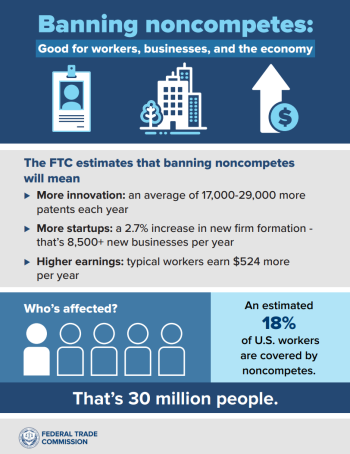
The FTC estimates that the final rule banning noncompetes will lead to new business formation growing by 2.7% per year, resulting in more than 8,500 additional new businesses created each year. The final rule is expected to result in higher earnings for workers, with estimated earnings increasing for the average worker by an additional $524 per year, and it is expected to lower health care costs by up to $194 billion over the next decade. In addition, the final rule is expected to help drive innovation, leading to an estimated average increase of 17,000 to 29,000 more patents each year for the next 10 years under the final rule.
Noncompetes are a widespread and often exploitative practice imposing contractual conditions that prevent workers from taking a new job or starting a new business. Noncompetes often force workers to either stay in a job they want to leave or bear other significant harms and costs, such as being forced to switch to a lower-paying field, being forced to relocate, being forced to leave the workforce altogether, or being forced to defend against expensive litigation. An estimated 30 million workers—nearly one in five Americans—are subject to a noncompete.
Under the FTC’s new rule, existing noncompetes for the vast majority of workers will no longer be enforceable after the rule’s effective date. Existing noncompetes for senior executives - who represent less than 0.75% of workers - can remain in force under the FTC’s final rule, but employers are banned from entering into or attempting to enforce any new noncompetes, even if they involve senior executives. Employers will be required to provide notice to workers other than senior executives who are bound by an existing noncompete that they will not be enforcing any noncompetes against them.
In January 2023, the FTC issued a proposed rule which was subject to a 90-day public comment period. The FTC received more than 26,000 comments on the proposed rule, with over 25,000 comments in support of the FTC’s proposed ban on noncompetes. The comments informed the FTC’s final rulemaking process, with the FTC carefully reviewing each comment and making changes to the proposed rule in response to the public’s feedback.
In the final rule, the Commission has determined that it is an unfair method of competition, and therefore a violation of Section 5 of the FTC Act, for employers to enter into noncompetes with workers and to enforce certain noncompetes.
The Commission found that noncompetes tend to negatively affect competitive conditions in labor markets by inhibiting efficient matching between workers and employers. The Commission also found that noncompetes tend to negatively affect competitive conditions in product and service markets, inhibiting new business formation and innovation. There is also evidence that noncompetes lead to increased market concentration and higher prices for consumers.
Alternatives to Noncompetes
The Commission found that employers have several alternatives to noncompetes that still enable firms to protect their investments without having to enforce a noncompete.
Trade secret laws and non-disclosure agreements (NDAs) both provide employers with well-established means to protect proprietary and other sensitive information. Researchers estimate that over 95% of workers with a noncompete already have an NDA.
The Commission also finds that instead of using noncompetes to lock in workers, employers that wish to retain employees can compete on the merits for the worker’s labor services by improving wages and working conditions.
Changes from the NPRM
Under the final rule, existing noncompetes for senior executives can remain in force. Employers, however, are prohibited from entering into or enforcing new noncompetes with senior executives. The final rule defines senior executives as workers earning more than $151,164 annually and who are in policy-making positions.
Additionally, the Commission has eliminated a provision in the proposed rule that would have required employers to legally modify existing noncompetes by formally rescinding them. That change will help to streamline compliance.
Instead, under the final rule, employers will simply have to provide notice to workers bound to an existing noncompete that the noncompete agreement will not be enforced against them in the future. To aid employers’ compliance with this requirement, the Commission has included model language in the final rule that employers can use to communicate to workers.
The Commission vote to approve the issuance of the final rule was 3-2 with Commissioners Melissa Holyoak and Andrew N. Ferguson voting no. Commissioners’ written statements will follow at a later date.
The final rule will become effective 120 days after publication in the Federal Register.
Once the rule is effective, market participants can report information about a suspected violation of the rule to the Bureau of Competition by emailing noncompete@ftc.gov.
Get MHF Insights
News and tips for your healthcare freedom.
We never spam you. One-step unsubscribe.
Sponsors

J & DE Family Charitable Fund

Friends
of MHF

Kelly Grotendiek
Philip Harbach
Dale Johnson
Drs. Jeffrey and Joni Jones
Vickie Kahle
Tammy Kipen
Marlin & Kathy Klumpp
Melanie Kurdys
Ruth Nobel
Patrick Peterson
Stephanie Poortenga
Jeanne Smit
Ben and Hope Staal
John Tuinstra
Jacki VanHuis
Sandy Walker
Sign Up for MHF Insights to keep up on the latest in Michigan Health Policy