This Map Shows Every State Restricting SNAP Benefits Across the U.S. — And What That Means for Families
By Alexandra Foster - December 17, 2025
Credit: Map: Shutterstock; Design: The Kitchn
It wasn’t too long ago that theSupplemental Nutritional Assistance Program(SNAP) came under fire and wasthreatened to be halted indefinitelyon November 1, with recipients not receiving their benefits amidst a government shutdown. Following an order by a federal judge and the end of the government shutdown, recipients have slowly been receiving their SNAP benefits since then.
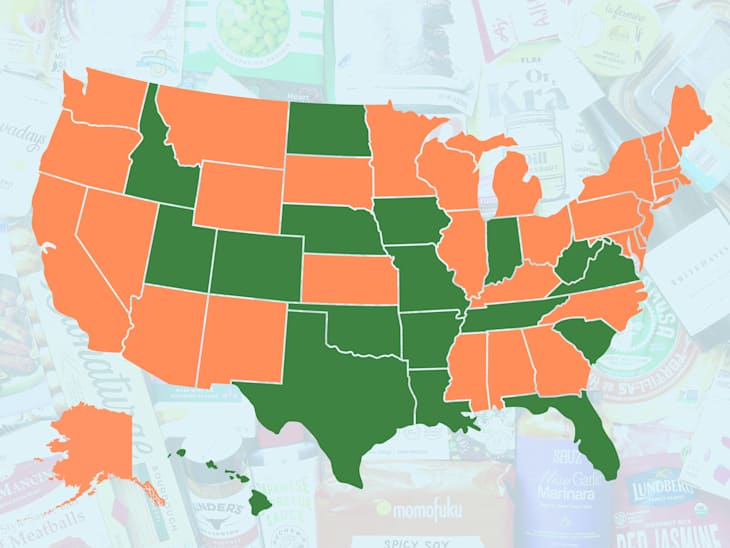
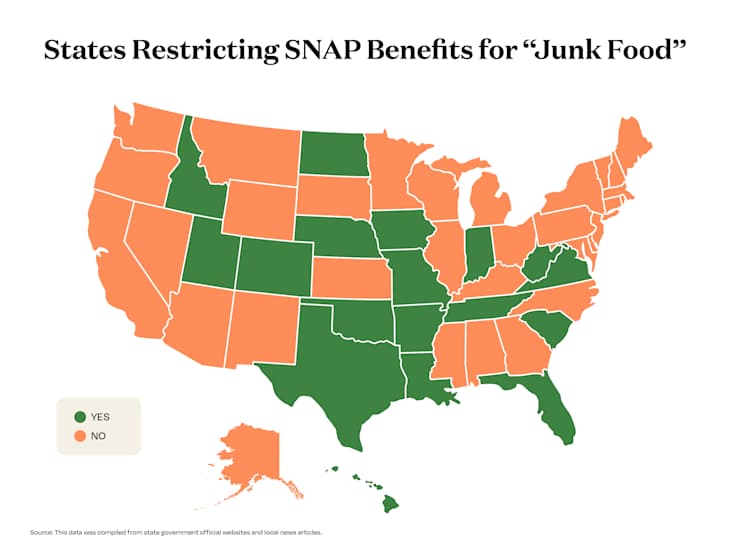
Well, SNAP is back in the news once again following new restrictions to the benefit41 million Americans rely on. As of December 10, 2025, theUSDA has approved waiversissued by 18 states placing restrictions on what can be purchased with SNAP benefits as part of theMake America Healthy Again(MAHA) initiative. The new restrictions will go into effect in 2026.
While the prohibited items vary by state, generally food labeled as “junk food” — including things like soda, energy drinks, candy, and prepared desserts — is what’s being targeted. The states include Arkansas, Colorado, Florida, Hawaii, Idaho, Indiana, Iowa, Louisiana, Missouri, Nebraska, North Dakota, Oklahoma, South Carolina, Tennessee, Texas, Utah, Virginia, and West Virginia — and the restrictionswill impact roughly 14 million people.
Credit: Map: Shutterstock; Design: The Kitchn
“President Trump has made it clear: We are restoring SNAP to its true purpose — nutrition,” said Secretary of Agriculture, Brooke Rollins. “Under the MAHA initiative, we are taking bold, historic steps to reverse the chronic diseases epidemic that has taken root in this country for far too long.”
Some of the politicians from these states have also released statements on the impending bans. North Dakota Governor Kelly Armstrong said, “By investing in healthier food purchases with SNAP, we are taking a proactive step toward becoming the healthiest state in the nation.” South Carolina Governor Henry McMaster called it a “light-touch, common-sense approach to strengthen the SNAP program. By encouraging families to purchase healthy, nutritious food — and not junk food — we ensure federal taxpayer dollars are used to their maximum benefit.”
While it has been shown thatultra-processed foods are linked to negative health outcomesand can increase the risk of cardiovascular diseases like heart attack, high blood pressure, and stroke, what’s missing here is nuance onwhyandwhenSNAP recipients buy “junk food.”
I recall a sobering moment during my time volunteering at a food pantry when one of the customers told me that SNAP was the only way she was able to afford a birthday cake and other snacks for her daughter’s 5th birthday party.
Food is a means of connection, a way of bringing people together in community, and often enjoyed at celebrations. (I mean, what was the last holidayor partyyou attended that didn’t have food?) With these bans in place, recipients in these states might have to make difficult decisions during times that are meant to alleviate stress and bring joy.
It also raises the question: Why are SNAP recipients being singled out? We’re in challenging and divisive times economically as it stands, and further placing restrictions on a specific group is only continuing the divide. If the goal is to make America as a whole healthier, addressing one part of the population doesn’t quite seem to be the right solution.
Food stamp recipients sue USDA over restrictions on candy, energy drinks By Joseph Choi - March 12, 2026
Recipients of the Supplemental Nutrition Assistance Program (SNAP) filed a lawsuit against the U.S. Department of Agriculture (USDA) on Wednesday, challenging its food restriction waivers that reduce the types of foods that can be purchased with benefits.
Represented by the National Center for Law and Economic Justice (NCLEJ), a nonprofit focused on advancing justice for low-income families, five SNAP recipients from Colorado, Iowa, Nebraska, Tennessee and West Virginia sued the USDA for implementing its waiver restriction pilot projects.
The restriction waivers bar SNAP recipients from using their benefits on junk foods, sodas, energy drinks or other “non-nutritious items.” The USDA has approved 22 restriction waivers so far, with the types of barred foods varying across states.
The USDA declined to comment on the pending lawsuit, directing inquiries to the Justice Department’s Office of Public Affairs.
“The food restriction waivers contain no exceptions for individual medical, nutritional, or household circumstances. Instead, the food restriction waivers place on recipients and retailers the responsibility for determining whether a particular product is a permissible SNAP purchase under each state’s altered definition of ‘food,'” the suit reads.
The suit stated that Amanda Johnson, one of the plaintiffs in the suit, would no longer be able to purchase the foods that her daughter, a disabled teenager with avoidant/restrictive food intake disorder (ARFID), eats once the restrictions in Tennessee go into effect.
“Because of her daughter’s ARFID, she can safely consume only a very limited number of ‘safe foods,'” the lawsuit says. “If she is unable to eat those foods, the only alternative is nutrition through a feeding tube. Her physicians have advised Plaintiff Johnson to provide her daughter with whatever foods she is able to eat in order to avoid nutritional deterioration and invasive medical intervention.”
The suit alleged that USDA violated the Administrative Procedures Act. Plaintiffs are asking that the pilot programs be declared unlawful, delay the implementation of any approved waivers, block any waivers that have not yet gone into effect and stop any active waivers.