This Map Shows Every State Restricting SNAP Benefits Across the U.S. — And What That Means for Families
By Alexandra Foster - December 17, 2025
Credit: Map: Shutterstock; Design: The Kitchn
It wasn’t too long ago that theSupplemental Nutritional Assistance Program(SNAP) came under fire and wasthreatened to be halted indefinitelyon November 1, with recipients not receiving their benefits amidst a government shutdown. Following an order by a federal judge and the end of the government shutdown, recipients have slowly been receiving their SNAP benefits since then.
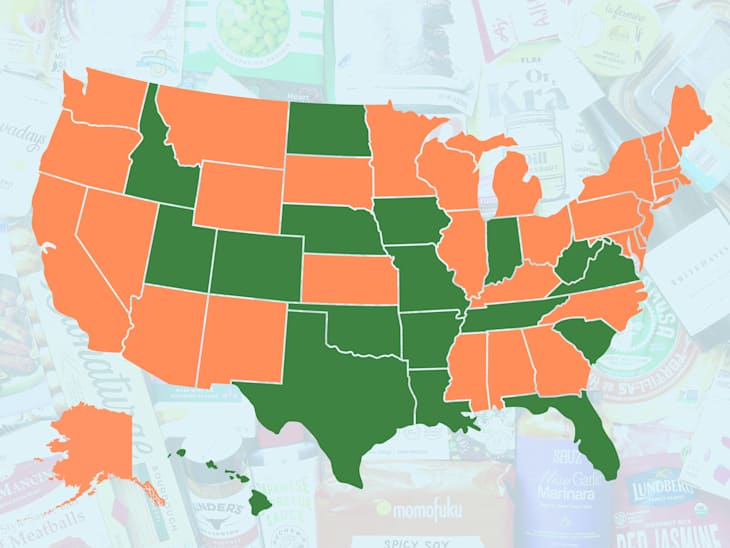
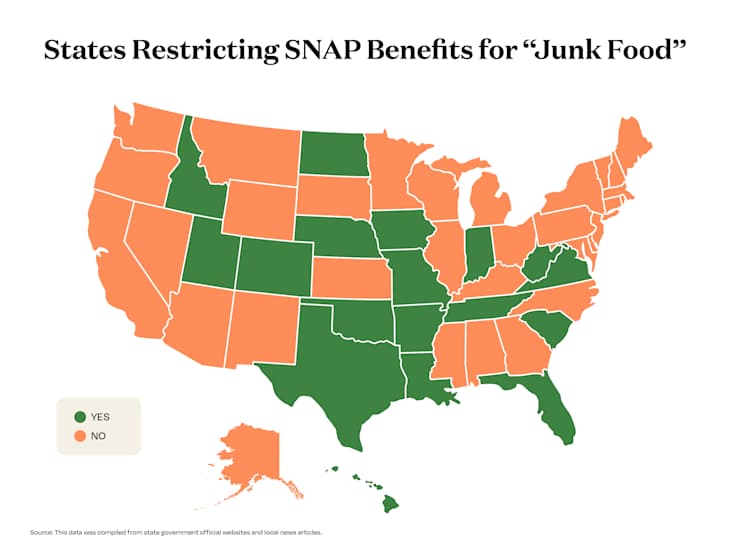
Well, SNAP is back in the news once again following new restrictions to the benefit41 million Americans rely on. As of December 10, 2025, theUSDA has approved waiversissued by 18 states placing restrictions on what can be purchased with SNAP benefits as part of theMake America Healthy Again(MAHA) initiative. The new restrictions will go into effect in 2026.
While the prohibited items vary by state, generally food labeled as “junk food” — including things like soda, energy drinks, candy, and prepared desserts — is what’s being targeted. The states include Arkansas, Colorado, Florida, Hawaii, Idaho, Indiana, Iowa, Louisiana, Missouri, Nebraska, North Dakota, Oklahoma, South Carolina, Tennessee, Texas, Utah, Virginia, and West Virginia — and the restrictionswill impact roughly 14 million people.
Credit: Map: Shutterstock; Design: The Kitchn
“President Trump has made it clear: We are restoring SNAP to its true purpose — nutrition,” said Secretary of Agriculture, Brooke Rollins. “Under the MAHA initiative, we are taking bold, historic steps to reverse the chronic diseases epidemic that has taken root in this country for far too long.”
Some of the politicians from these states have also released statements on the impending bans. North Dakota Governor Kelly Armstrong said, “By investing in healthier food purchases with SNAP, we are taking a proactive step toward becoming the healthiest state in the nation.” South Carolina Governor Henry McMaster called it a “light-touch, common-sense approach to strengthen the SNAP program. By encouraging families to purchase healthy, nutritious food — and not junk food — we ensure federal taxpayer dollars are used to their maximum benefit.”
While it has been shown thatultra-processed foods are linked to negative health outcomesand can increase the risk of cardiovascular diseases like heart attack, high blood pressure, and stroke, what’s missing here is nuance onwhyandwhenSNAP recipients buy “junk food.”
I recall a sobering moment during my time volunteering at a food pantry when one of the customers told me that SNAP was the only way she was able to afford a birthday cake and other snacks for her daughter’s 5th birthday party.
Food is a means of connection, a way of bringing people together in community, and often enjoyed at celebrations. (I mean, what was the last holidayor partyyou attended that didn’t have food?) With these bans in place, recipients in these states might have to make difficult decisions during times that are meant to alleviate stress and bring joy.
It also raises the question: Why are SNAP recipients being singled out? We’re in challenging and divisive times economically as it stands, and further placing restrictions on a specific group is only continuing the divide. If the goal is to make America as a whole healthier, addressing one part of the population doesn’t quite seem to be the right solution.
Food stamp recipients sue USDA over restrictions on candy, energy drinks By Joseph Choi - March 12, 2026
Recipients of the Supplemental Nutrition Assistance Program (SNAP) filed a lawsuit against the U.S. Department of Agriculture (USDA) on Wednesday, challenging its food restriction waivers that reduce the types of foods that can be purchased with benefits.
Represented by the National Center for Law and Economic Justice (NCLEJ), a nonprofit focused on advancing justice for low-income families, five SNAP recipients from Colorado, Iowa, Nebraska, Tennessee and West Virginia sued the USDA for implementing its waiver restriction pilot projects.
The restriction waivers bar SNAP recipients from using their benefits on junk foods, sodas, energy drinks or other “non-nutritious items.” The USDA has approved 22 restriction waivers so far, with the types of barred foods varying across states.
The USDA declined to comment on the pending lawsuit, directing inquiries to the Justice Department’s Office of Public Affairs.
“The food restriction waivers contain no exceptions for individual medical, nutritional, or household circumstances. Instead, the food restriction waivers place on recipients and retailers the responsibility for determining whether a particular product is a permissible SNAP purchase under each state’s altered definition of ‘food,'” the suit reads.
The suit stated that Amanda Johnson, one of the plaintiffs in the suit, would no longer be able to purchase the foods that her daughter, a disabled teenager with avoidant/restrictive food intake disorder (ARFID), eats once the restrictions in Tennessee go into effect.
“Because of her daughter’s ARFID, she can safely consume only a very limited number of ‘safe foods,'” the lawsuit says. “If she is unable to eat those foods, the only alternative is nutrition through a feeding tube. Her physicians have advised Plaintiff Johnson to provide her daughter with whatever foods she is able to eat in order to avoid nutritional deterioration and invasive medical intervention.”
The suit alleged that USDA violated the Administrative Procedures Act. Plaintiffs are asking that the pilot programs be declared unlawful, delay the implementation of any approved waivers, block any waivers that have not yet gone into effect and stop any active waivers.
Kudos to CapCon's Editorial Dispatch for cute wordplay! 😆
April 17, 2026
Two criminals stole $1.1 million from Michigan’s Supplemental Nutrition Assistance Program over nine years by stealing people’s identities who live out-of-state and using them to apply for benefits.
The state health department won’t release documents about the case to Michigan Capitol Confidential. Doing so would "interfere with ongoing law enforcement proceedings and disclose law enforcement investigative techniques or procedures,” the agency claimed.
The report shows how criminals adapt their methods to steal from Michigan’s poorest residents. Michigan will soon be the first state in the Midwest to upgrade its SNAP cards for 1.4 million residents who rely on the program to eat.
That upgrade will help deter card skimmers but won’t stop criminals who use stolen identities to apply for taxpayer-funded benefits, according to Haywood Talcove of LexisNexis Risk Solutions.
SNAP fraud happens in five main ways.
SNAP recipients can lie about their income or the number of people living in their home. Or someone can apply with fake or stolen information.
SNAP recipients can sell their Bridge cards online or in-person for cash.
SNAP recipients can traffic benefits by trading them to retailers for ineligible items such as alcohol, tobacco, or lottery tickets.
Criminals can install fake credit card readers that capture swiped card data and either spend those benefits or sell them on the dark web. Michigan’s Bridge cards can be spent at SNAP retailers nationwide.
Criminals steal the identities of others and then use that information to steal from taxpayers.
Federal judge blocks bans on SNAP use for soda By Tara Suter - June 23, 2026
A federal judge has blocked bans on the usage of the Supplemental Nutrition Assistance Program (SNAP) for soda enacted by the Trump administration.
“Congress defined what ‘food’ is supposed to be, and it did not authorize the agency to amend or waive the definition it enacted. It did not authorize the agency to cut types of food out of SNAP entirely,” U.S. District Judge Amy Berman Jackson wrote in a Monday filing, referencing the U.S. Department of Agriculture (USDA).
“It set out clearly the type of experimental projects that could be tested to address the unquestionably serious health issues attributed to the rise of obesity in the population in general and particularly the low-income population,” she added.
According to the U.S. District Court for the District of Columbia filing, five states, including Iowa, Nebraska, West Virginia, Colorado and Tennessee, “submitted requests to the USDA to conduct pilot projects” between April and August 2025 attempting to “waive the federal definition of ‘food,’” removing certain items from that definition including soft drinks and soda.
Represented by the National Center for Law and Economic Justice, a nonprofit focused on advancing justice for low-income families, five SNAP recipients from those five states had sued the USDA for implementing its waiver restriction pilot projects.
Jackson, an appointee of former President Obama, wrote in her order that, per USDA policy, the Food and Nutrition Act of 2008’s definition of “food” guides what SNAP benefits can purchase.
The USDA and its secretary, Brooke Rollins, issued approval letters for the states’ requests, according to the filing. Jackson said in her ruling that she was vacating and remanding these letters.
The department has approved “food restriction” waivers in 23 states overall, according to Reuters. The restrictions were endorsed by Health and Human Services Secretary Robert F. Kennedy Jr. as part of the “Make America Healthy Again” movement.
When reached for comment, a USDA spokesperson said, “the idea that taxpayer funds should not be used to purchase junk food should not be controversial.”
“USDA will not be backing down from the fight to Make America Healthy Again, including for families and communities reliant on SNAP,” they added.
News Story Michigan supersizes fast food SNAP program
Federal reimbursements for restaurant meals go from $27K to $2.4M between 2022 and 2025: an 8,900% spike for state
Michigan Capitol Confidential Staff | June 25, 2026
Michigan is seeing a spike in the popularity of a U.S. Department of Agriculture program that allows some people on food stamps to use their Bridge cards at fast food restaurants.
The state’s reimbursements from the federal government for the Restaurant Meals Program increased geometrically between 2022 and 2025. Payments from Washington rose from $26,656 in 2022 to $37,255 in 2023. The figure jumped to $580,568 in 2024 and last year spiked to $2.4 million.
From 2024 to 2025, the increase in reimbursement increased by 313%, according to the data from a Freedom of Information Act request that was filed with the U.S. Department of Agriculture.
The number of restaurants participating in the program rose from 50 in 2022 to 292 in 2025.
The Restaurant Meals Program was launched Jan. 1, 2021. It allows people on the Supplemental Nutrition Assistance Program (SNAP) who are elderly, homeless and disabled to use their electronic benefit transfer cards at participating restaurants, many of which are fast-food chains such as McDonald’s, Subway, KFC and Taco Bell.
The Restaurant Meals Program is offered to people who may have trouble getting hot prepared meals.
“The Restaurant Meal Program expands options for individuals who need hot prepared meals,” said Elizabeth Hertel, director of the Michigan Department of Health and Human Services in a 2024 statement. “Additional restaurants are joining the program regularly and the goal is to provide this service in every county in the state.”
Michigan is one of nine states to adopt the USDA program. The other states are Arizona, California, Illinois, Maryland, Massachusetts, New York, Rhode Island and Virginia.
Restaurants are not allowed to charge sales tax or include tips on RMP transactions. People eligible for the Restaurant Meal Program cannot charge alcohol or delivery fees on their cards.
In 2024, the state estimated that about 322,000 seniors and residents with disabilities and 52,000 homeless people were eligible to use their Bridge cards to buy meals at participating restaurants.
Pepsi's junk food sales choked. Is it the (now court enjoined) SNAP junk food ban, the GLP-1 agonist weight loss drugs, or just poor consumer finances? The ZeroHedge take:
"Results Were Tempered": Pepsi Blames US Snack Slump On Cash-Strapped Consumers By Tyler Durden - Thursday, July 09, 2026
PepsiCo blamed the second-quarter slowdown in its North American food unit on consumers tightening their belts. The period was marked by elevated pump prices tied to the US-Iran war, a squeeze that hit lower-income households the hardest and weighed on discretionary snack and beverage purchases.
Revenue in the company's North American food unit fell 2%, while volumes remained flat, even as the junk food giant slashed prices on some of its brands by as much as 15% earlier this year to lure working-class consumers.
"Results were tempered in the quarter as U.S. food and beverage category performance moderated with consumer budgets tightening due to rising inflationary pressures," CEO Ramon Laguarta stated in a press release.
"Our North America business was softer than we anticipated in the second quarter, and we now expect a more gradual improvement in performance trends for the balance of this year," CFO Steve Schmitt said in prepared remarks.
PepsiCo reaffirmed its full-year guidance and reported adjusted earnings of $2.20 a share for the second quarter, slightly above the Bloomberg Consensus estimate.
The company has also raised prices on some smaller bags and is expanding its product line to include more protein and fiber as consumer tastes shift toward healthier options.
Here's JPMorgan analyst Andrea Teixeira's first take on PepsiCo earnings:
The earnings beat was of lower quality, driven mostly by below-the-line items and OSG came in a tick below expectations as North America underperformance was offset by stronger International. PFNA turned negative again after a strong start in 1Q26, with volumes decelerating to flat vs. +2% in 1Q, as management noted that U.S. food and beverage category performance moderated in the second quarter amid higher inflationary pressures. Management reiterated guidance (in line with our expectations and preview), but is now expecting a more gradual improvement in trends in North America and is now embedding a ~1 point benefit to EPS from tariff refunds in the guidance (mostly occurring in 3Q and allocated to PBNA, with the company likely to use these tariff refunds to offset higher COGS and reinvest in A&M to reignite volumes). The company is also pointing to 4Q-weighted EPS growth in 2H. PEP turnaround is deep and investors should not expect a straight line as with most restructurings in CPGs, yet we think investors will need to get more reassurance in consumption data ahead in order to feel more confident that the ingredient reformulation, brand restaging and affordability actions are working.
Peter Grom of UBS' first take:
Initial Reaction: Negative. Heading into the print, given weaker tracked trends in North America our conversations suggested most anticipated organic sales to be under pressure with much of the debate centering on how company frames the full year outlook and the path from here. Against that backdrop, we think the print more or less played out as expected but was still disappointing on the surface relative to consensus as organic sales fell short, GM/ OPM came in below with total company EPS ahead of expectations due to favorable below-the-line items. From a guidance perspective, the company maintained their outlook and while they did not point to the low end of the range (as some expected), management did outline that growth is expected to be 4Q weighted. While this is not surprising on the surface given the external environment and timing of input cost pressures, we would note that simply hitting the low end of the range implies +HSD EPS growth in 4Q against a tougher comparison on the bottom line - which some are likely to view as optimistic. In many ways we do not think the print will be viewed as thesis changing and although it would not entirely surprise us to see shares trade higher today given positioning, based on the quality of the print/outlook alone, we would expect shares to trade lower this morning (currently -1.2% pre-market).
Separate but notable is a chart from food retail equity analyst Scott Marks at Jefferies that shows a sharp decline in average benefits per SNAP participant (read report) ...
Pepsi shares slipped nearly 2% in premarket trading Thursday. The stock is down about 1% year-to-date and lagging the broader S&P 500 index.
Inquiring minds want to know: Did Pepsi pay off U.S. District Judge Amy Berman Jackson? Our judicial system has become a fount of corruption.