







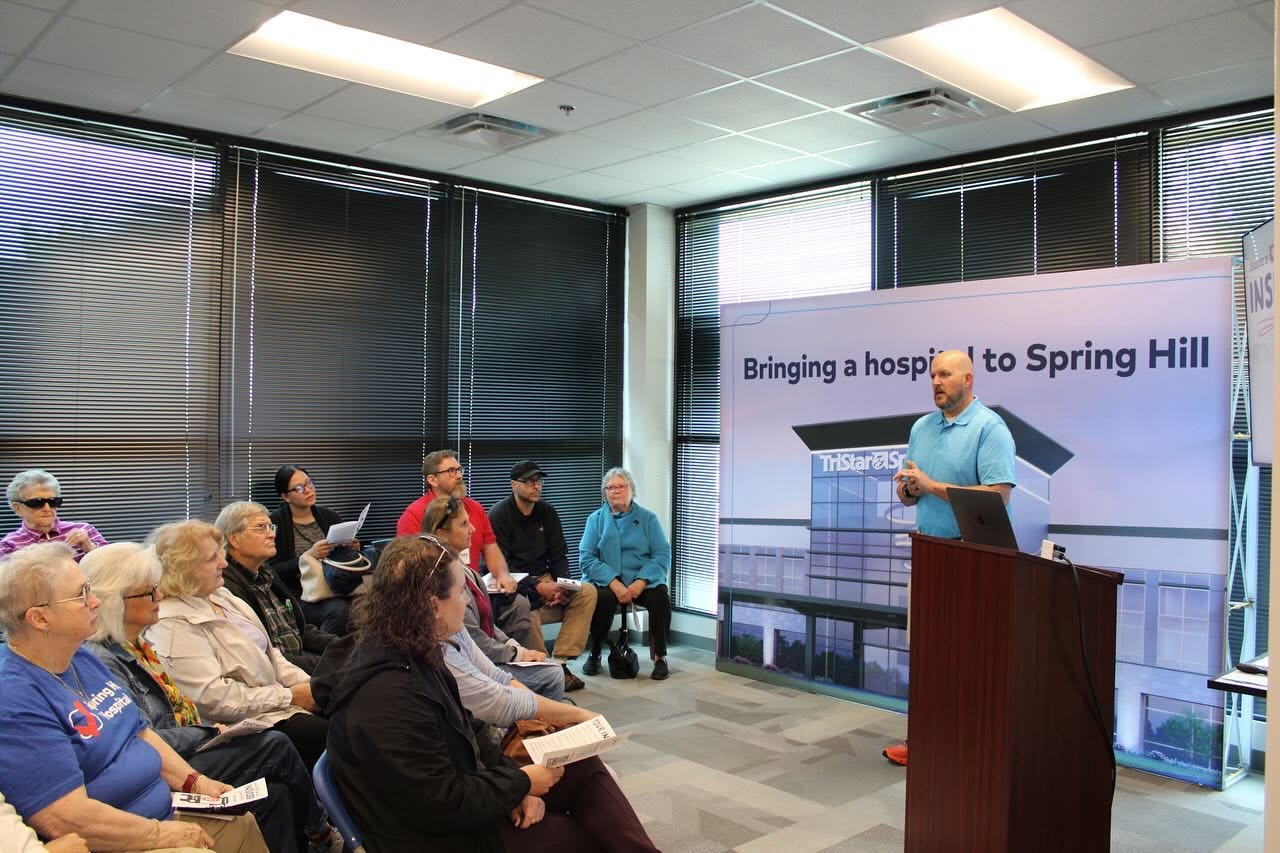




Michigan healthcare freedom community forum

Pacific Legal Foundation reports good news for healthcare startups.
Not sure if this helps Michigan directly, but as an application of constitutional principles, it sure can't hurt.
Victory for Ohio family! Sixth Circuit rolls back certificate-of-need laws
The Sixth Circuit Court of Appeals just delivered a blow to economic protectionism in a case Pacific Legal Foundation has been litigating for four years.
Phillip Truesdell and his children run Legacy Medical Transport, a small, non-emergency ambulance service in Aberdeen, Ohio, a stone’s throw from the Kentucky border. The company is fully licensed in Ohio and transports patients to and from nursing homes, doctors’ offices, and hospitals.
But despite receiving numerous calls for service from Kentucky, the Truesdells were barred from transporting Kentuckian patients without a certificate of need (CON), which Kentucky refused to grant.

Legacy Medical Transport is in Aberdeen, Ohio, a town of 1,515 residents just across a bridge from Kentucky.
Kentucky’s refusal wasn’t about health or safety; it was about protectionism.Certificate-of-need laws force new businesses to prove to state regulators that there’s a need for their business before they can operate. Existing businesses are allowed to weigh in and can effectively issue a “Competitor’s Veto,” preventing would-be competitors from entering the market.
That’s what happened in the Truesdells’ case.
After the Truesdells applied for a certificate of need with the Kentucky Cabinet for Health and Family Services, four Kentucky ambulance companies protested. They claimed there was no need for Legacy’s ambulances in Kentucky.
But the Truesdells regularly received calls from Kentucky patients and estimated Kentucky’s law prevented them from taking about 300 jobs per year.
When Pacific Legal Foundation first met Phillip Truesdell, his story struck such a chord with PLF staff that we produced a short documentary about his fight for his business.
“Kentucky’s got a great need for ambulance services,” Phillip said in interviews for the documentary. He’s a plain-spoken man, quick to smile but also blunt. “I’m not no rich man, but I don’t consider myself a poor man either. I consider myself a working man,” he said. “Nobody gave me nothing. I’ve never asked anyone for a handout.” All he wanted was the opportunity to run his business—to answer calls his company was already receiving.
With PLF’s help, the Truesdells sued the Kentucky Cabinet for Health and Family Services in 2019. A district court ruled against them in 2020. But last week, in a victory for Phillip and his family, the Sixth Circuit ruled that Kentucky can’t use certificate-of-need requirements to restrict ambulance trips between Kentucky and other states just because a state agency determines new competition is “undesirable.”
The Commerce Clause of the Constitution gives Congress—not Kentucky regulators—the exclusive power to regulate interstate commerce. “[T]he Commerce Clause was designed to stop the economic protectionism that had spread among the States at the time of the founding,” the court noted in its decision. By preventing Legacy Medical Transport from transporting Kentucky patients to Ohio hospitals, the court ruled, state regulators violated the Commerce Clause.
Unfortunately, the Sixth Circuit’sdecisiondoesn’t overturn Kentucky’s certificate-of-need law entirely. State regulators can continue to require a certificate of need forintrastate ambulance trips—that is, Legacy Medical Transport still won’t be able to transport Kentuckians from one location to another within Kentucky without first securing a CON. The Sixth Circuit acknowledged that Kentucky’s certificate-of-need law “may well be folly,” but for trips within Kentucky’s borders, the costs of the law “are costs that Kentucky’s legislature has inflicted on its own people.”
Not so for interstate trips: Kentucky can’t burden out-of-state businesses by restricting interstate commerce, the court held.
For Phillip Truesdell, the decision is a relief that opens up new possibilities for his growing business. When PLF interviewed Phillip for our documentary, we asked him who should have the right to start a business.
“Anybody that’s got breath in them,” Phillip said.
Joshua Polk rejoined the Pacific Legal Foundation’s Sacramento office in 2019 after completing a summer clerkship in 2018. He practices within several PLF’s litigation areas including economic liberty and property rights.
Growing up in the deep south, Joshua was raised with an appreciation of individualism and a skepticism toward overreaching government. In college, he solidified his deeply ingrained love of liberty by studying Austrian economics and becoming a founding member of his school’s Young Americans for Liberty chapter.
Joshua earned B.A. degrees in Foreign Languages, Criminal Justice, and Psychology from the University of Southern Mississippi and a J.D. from the University of Alabama School of Law. During law school he was the Editor-in-Chief of the Alabama Civil Rights and Civil Liberties Law Review. In this position, he hosted several liberty-focused events with topics ranging from criminal justice reform to equality in education.
With his free time, Joshua enjoys traveling, watching Colts football, and reading science-fiction.
Joshua is a member of the bar only in the state of California.
Original link contains video.
https://pacificlegal.org/victory-for-ohio-family-sixth-circuit-rolls-back-certificate-of-need-laws/
Faced with extensive hospital closures, Georgia recently revisited its CON laws. Some background is helpful leading into the Kaiser Family Foundation longform article.
A healthy healthcare market can be destroyed in many ways, but perhaps the most fundamental principles is: No physicians, no hospitals.
Georgia reported in 2019 that "Nine of the state’s 159 counties have no physician at all. Each is in a rural area of the state. The report also finds that in 2018, 76 counties had no ob/gyn, and 60 were without a pediatrician."
According to analysis I read some 20 years ago, Georgia's cascade to physician desert began with a series of three ill-conceived jury decisions awarding large sums. The cases involved tragic infant losses, for which a scapegoat. Physician care in each case were not at fault, but the juries considered them wealthy enough to pay.
End result: malpractice insurance skyrocketed in this tri-county area of Georgia. Physicians couldn't keep up, so they left.
https://kffhealthnews.org/news/article/certificate-of-need-con-georgia-hospitals-bipartisan/
Bipartisan Effort Paves Way for Reviving Shuttered Hospitals in Georgia
ATLANTA — At the shuttered Atlanta Medical Center, a “Stronger Together” mural sends a hopeful message near a summer spray of hydrangeas. The campus was mostly quiet on a recent weekend, since AMC closed almost two years ago. A lone security vehicle sat behind a chain-link fence, and pedestrians passed by without even a glance.
The two hospitals — one inner-city, the other rural — faced some of the same financial pressures, including not having enough patients with private insurance.
This year, they also shared the attention of some of Georgia’s most powerful lawmakers. Legislation signed in April by Gov. Brian Kemp, a Republican, included a provision pushed by U.S. Sen. Jon Ossoff, a Democrat.
The law amends the state’s “certificate of need” system, which allows existing hospitals and other health facilities to block would-be competitors’ plans to expand by arguing there’s insufficient need for their services.
Certificate of need laws exist in 35 states and Washington, D.C., according to the National Conference of State Legislatures. The hospital industry, especially nonprofit facilities, generally support the rules, and have argued they reduce health care costs and preserve access to quality medical services. Under CON requirements, health providers must obtain approval from the state before offering some new services or before building or expanding facilities.
Whether the laws improve care or reduce costs is questionable, researchers have found, and critics say more competition would decrease spending by insurers and consumers. In 2018, the Trump administration issued a report recommending that states repeal or revise their certificate of need requirements, arguing they increase health care costs.
“The evidence is pretty darn overwhelming that CON laws don’t achieve the initially stated goals of increasing access, lowering costs, and improving quality,” said Matthew Mitchell, a senior research fellow at West Virginia University.
Certificate of need laws can reduce fraud, Sullivan said. Florida repealed its certificate of need requirements for hospitals and many other health providers following the Trump administration’s recommendation. Fraud accelerated in the state after regulations were phased out, he said.
“At least when you file a CON, there’s at least a minimum of investigation,” Sullivan said.
He argued another benefit of the laws is that they frequently mandate a baseline level of charity care.
Other Southern states recently peeled back their certificate of need laws. Tennessee’s legislature passed a bill this year exempting more medical providers from needing to apply for a certificate. North Carolina rolled back some restrictions in an overhaul that paved the way for Medicaid expansion last year. South Carolina made a significant change to its rules last year.
This year, Republicans in Georgia’s legislature attempted to repeal the state’s certificate of need rules. The effort fell short in the face of fervent hospital opposition.
The narrower legislation that Kemp signed would instead ease the rules for building rural hospitals and exempts a potential new hospital that would partner with Morehouse School of Medicine, one of the country’s few historically Black medical schools.
That could potentially fill much of the gap left by Atlanta Medical Center’s closing.
Hospital industry officials said Morehouse would probably need a well-heeled partner, and Atrium Health, part of Charlotte, North Carolina-based Advocate Health, may be a logical match. The growth-oriented nonprofit health system has partnered with Morehouse Healthcare to run a clinic in East Point, south of Atlanta, and has a growing presence in the state. Both Morehouse and Atrium declined to discuss a potential hospital partnership with KFF Health News.
The shuttered AMC main campus, meanwhile, is ensnared in a moratorium the city imposed on redeveloping the site — a response to the jolting decision by its owner, Wellstar Health System, to close the hospital.
In 2022, Mayor Andre Dickens issued an executive order temporarily halting any new development on the site. He has criticized the “unusually abrupt closure of one of Atlanta’s most important medical centers.”
Atlanta’s city council extended the ban another 120 days in June.
A new inner-city hospital “would be a heavy lift financially,” said Josh Berlin, CEO of rule of three, an Atlanta-based health care consulting firm. That’s because it would draw largely from the area’s high level of uninsured and Medicaid patients. Georgia is one of 10 states that have not fully expanded Medicaid, and thus has a high rate of uninsured patients.
“You’ve got a community that is struggling to find care in the wake of the Atlanta Medical Center closure,” he said.
Grady Memorial Hospital and other Atlanta facilities have seen a bump in patient volume since the closure of AMC. Grady is regularly deemed “dangerously overcrowded” in one state dashboard.
The need to handle additional patients has sped up expansion plans for Grady, including adding more than 150 beds, said its chief strategy officer, Shannon Sale. “We knew that was going to be needed over time. The Atlanta Medical Center closure sped up that process,” she said.
In southwestern Georgia, plans are more modest.
Community leaders, including Whatley, are awaiting the results of a feasibility study that is expected to propose a downsized “rural emergency hospital,” a new federal designation that directs extra funding to eligible facilities.
The program guarantees hospitals in rural communities extra Medicare payments and an additional payment of about $3.2 million a year if they close costly inpatient services and offer only emergency and outpatient care.
Ossoff won almost $12 million in three different appropriations bills to support a rural emergency hospital in Cuthbert. He said he met with state leaders to secure the provision in the Georgia certificate of need bill that would allow it to reopen. Southwest Georgia Regional Medical Center would also have to get an exemption from federal officials to qualify for a rural emergency hospital because of its closing date.
“This is a very challenging thing to do, and we’ve still got significant hurdles to clear,” Ossoff told KFF Health News.
Even if it reopens, the Cuthbert facility will face the same pressures that led to its shuttering in the first place — what Ossoff called “failures of state policy.” At the time, he cited Georgia’s decision not to fully expand Medicaid in the wake of the closure.
Brenda Clark, who works in a wellness center across the street from the closed Cuthbert hospital, said some locals are skeptical about the facility reopening.
“It’s much needed. People are hoping and praying we get it back,” she said. But “there are some people who say, ‘We’ll believe it when we see it.’”
Get MHF Insights
News and tips for your healthcare freedom.
We never spam you. One-step unsubscribe.
Sponsors

J & DE Family Charitable Fund

Friends
of MHF

Kelly Grotendiek
Philip Harbach
Dale Johnson
Drs. Jeffrey and Joni Jones
Vickie Kahle
Tammy Kipen
Marlin & Kathy Klumpp
Melanie Kurdys
Ruth Nobel
Patrick Peterson
Stephanie Poortenga
Jeanne Smit
Ben and Hope Staal
John Tuinstra
Jacki VanHuis
Sandy Walker
Sign Up for MHF Insights to keep up on the latest in Michigan Health Policy