













Michigan healthcare freedom community forum

The Mackinac Center for Public Policy takes the long view of government's role in adjusting population numbers.
https://www.mackinac.org/blog/2023/history-lessons-for-policymakers-pondering-our-population-problem
History lessons for policymakers pondering our population problem
Michigan feared a similar crisis in the 1970s
December 12, 2023The effort to fix the state’s population problem 50 years ago started with a Republican state senator from Ann Arbor. Population forecasts troubled Sen. Gilbert Bursley. A Michigan State University professor noted in 1962 that the state had just surpassed eight million inhabitants. The professor projected that Michigan would reach 9.3 million souls by 1970.
Bursley launched a multi-prong effort to curb this apparent boom. He introduced legislation in 1970 to legalize abortion in certain circumstances, arguing that this would help slow the state’s population growth. Whitmer makes the opposite argument today, believing that easy access to abortion services can boost the population. Bursley also wanted to eliminate tax breaks for families with more than two children. Another bill he sponsored would create a population commission to “suggest legislation which might favor stabilization of our population.”
Fears of overpopulation were common back then. The White House studied the issue. “Zero population growth” was a phrase experts used that neatly articulated their goal. The Malthusian trap is easy to understand: A growing population consumes increasing amounts of finite resources. Project those trends into the future, and pretty soon, we’ve run out of food. The state’s natural resources department was sounding the alarm in 1970, publicizing estimates of how many people Michigan farmers could feed.
This is the first lesson for today’s policymakers concerned about population stagnation: Don't get carried away with projections. In the early ‘70s, eggheads predicted a “population explosion.” Even though it was clear within the decade that these predictions were off — Michigan’s population was 8.9 million in 1970, not the 9.3 million predicted earlier — concerns of overcrowding persisted. One article claimed the state’s “quality of life” was “on the line” because the state population would hit 13.5 million in 2000 “unless we change our ways.” Those concerns didn’t age well, and thankfully, not much more than a proposed government commission came of it.
In the population scare of 50 years ago, the natural resources department recommended “relax[ing] social pressures which glorify marriage and parenthood.” It forgot to mention how this might be achieved. “Proposed methods for dealing with population growth range from the stupid and unrealistic to the frightening and ruthless,” a Detroit Free Press feature writer remarked, perhaps thinking of ideas like that one.
The second lesson is to be on high alert for impractical policy proposals. These tend to surface when policymakers are dreaming up solutions to elusive problems that are projected to cause some unknowable harm at some unknowable time in the distant future.
Whitmer’s population council will be spared having to consider ideas as wild as the ones that were peddled back then, such as colonizing the moon or putting contraceptives in the water supply. The more likely threat for the council is wasting time on policies that have no established relationship to population growth. The council heard recommendations to make community college tuition free and to improve teacher training programs. These might sound good on paper, but how, exactly, would they increase the state’s population? Are we supposed to believe that hordes of people would pick up and move from another state just for two free years of schooling or better trained teachers?
Nothing appears to have come of the effort to create a population commission in the 1970s. Bursley’s bill didn’t pass, and the Milliken administration started noticing that the decreasing birth rate “somewhat alleviated recent serious concerns.” It went on, “Many demographers are becoming almost optimistic that population control or limitation can indeed be left to individuals, and government regulations to guarantee stabilization of population will not be necessary.”
There’s the third lesson for today’s policymakers. The forces that drive broad population trends are largely beyond your control. The drivers of population change are multifaceted and impacted by amorphous social and cultural forces that no one is in charge of.
Hannah Kling recently analyzed the economic research on state-level population growth. “An important takeaway from the research is that there are limits on what state officials can accomplish to influence population trends,” she writes. Policies do matter, but lawmakers are not in control of the key determinants of state population.
The population problem of the 1970s was an illusion, but it whipped lawmakers into a frenzy anyway. To the extent it was a problem, it fixed itself without government intervention. This previous experience suggests policymakers should approach today’s alleged population problem with a helpful serving of humility. Their role in influencing population trends is limited, and they should focus on practical solutions to concrete and well-documented problems.
Michael Van Beek is director of research for the Mackinac Center for Public Policy. He joined the Mackinac Center in June 2009 as director of education policy. He has authored several studies for the Center as well as analysis and commentaries that have been published in The Wall Street Journal, National Review, The Hill, The Detroit News, the Detroit Free Press and elsewhere.
Van Beek obtained his graduate degree in history from Purdue University and his undergraduate degree from Hope College.
He lives in Midland, Mich., with his wife and three children. His favorite color is orange.
I addressed this issue a few years ago while writing for the Independent Women's Forum.
As federal Title X funding flows down, it impacts Michigan health policy and population as well.
Published by the Washington Examiner.
https://www.iwf.org/2021/11/04/archaic-title-x-spending-harms-women-and-the-birth-rate/
Archaic Title X Spending Harms Women And The Birth Rate
The Biden administration announced another reversal of a Trump-era policy, this one related to Title X, the federal government’s family planning program.
President Joe Biden has welcomed abortion providers back into Title X — and requested $340 million for it this year, an increase of $53.5 million over current funding. Instead of devolving into the usual abortion debate, we should defund Title X purely in light of today’s demographic realities.
Women are squarely at the center of Title X issues not only in pregnancy and childbearing, but also as the first line of healthcare for their families and at work. America is chronically and acutely short of healthcare staff. U.S. population numbers are plummeting, yet Title X imposes a moral judgment against reproduction.
America’s low fertility rate, driven in part by Title X, is exacerbating the already critical healthcare labor shortage. The American Association of Colleges of Nursing relates the nursing shortage to our population cliff. As more nurses retire, nursing school enrollment is falling behind, leaving fewer active nurses. At the same time, more elderly require more care.
The shortage is across all health professions. To help, some states open their borders with license reciprocity laws. Immigration can help in a limited way. After closing 120 beds for short staffing, Michigan’s Henry Ford Health System recently announced hiring hundreds of nurses from the Philippines. However, they were short 5,000 job applicants this year.
Shuffling people around the globe cannot solve a worldwide healthcare labor shortage post-COVID-19.
Common sense says baseline local staffing is the path to long-term sustainability. An “all-of-the-above” strategy includes the obvious: Stop spending to reduce fertility. Certainly, stop casting moral judgment on low-income women for pregnancy.
Proposed in 1968, Title X reacted to fears of population explosion and global famine. In contrast, we now face population collapse following a long downward trend in fertility rates. It would be disingenuous to pass this off simply as pandemic pressures or Generation Z character traits.
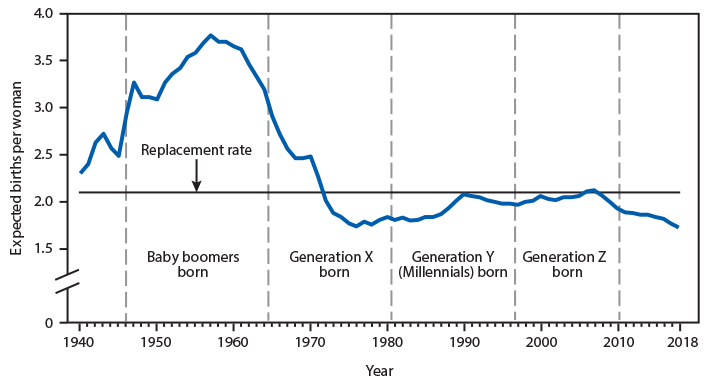
U.S. birth rates had already peaked in the 1950s, dropping below replacement level shortly after Title X passed. We regained sustainable levels only briefly in the past 50 years as federal spending continued to focus on lower birth rates through contraception and abortion.
The federal family planning approach is also morally flawed. Violating the privacy of a personal, moral decision, Title X policy has told three generations of low-income women that they should “plan” their families — code for having fewer children.
Based on archaic Cold War theories of population explosion, with a subtext of eugenics for the poor, this program is beyond outdated. It is biased, paternalistic, and based on numerous false premises.
Presently, many support Title X, likely because they believe that contraception is unaffordable for low-income women, and they want the government to offer a helping hand. But birth control is not unaffordable. Priced around $9 per month across the United States, birth control costs less than two Big Macs. Other recommended policy changes could drop cost and access barriers even lower.
Another unfair, underlying Title X assumption is that poor children are a burden on society. But in fact, the average person has more years of productivity than dependency. Most lower-income women and men work hard to independently support their children and raise them to become self-sustaining members of society.
Furthermore, some estimate that about 2 million couples are waiting to adopt — meaning there are as many as 36 waiting families for every child placed for adoption.
Other programs duplicate funding options for women’s family planning. In 2019, seven states were completely independent of Title X funding for family planning clinics. Six more had dropped below 50% dependence.
Given Title X conflicts with national interests and women’s private lives, the responsible federal health policy is to stop trying to reduce fertility and leave this personal decision to individuals. Congress has proposed eliminating Title X six times in the past, according to the National Family Planning and Reproductive Health Association.
Ultimately, responsibility for pregnancy belongs to parents. The government should not be playing a role here. While many people who call themselves “pro-choice” will cheer Biden’s latest move to bolster abortion clinics with Title X money, we should be wary of how this program erodes human resources and perniciously influences women’s personal autonomy and relationships.
Recently, Michigan Economic Development Corporation (MEDC) headlined this topic, featuring a Crain's Detroit article.
For those fortunate enought to have the $179 annual paid access, here's the link.
https://www.crainsdetroit.com/politics-policy/michigans-growth-office-will-focus-growing-population
Michigan unveils Growth Office to focus on growing population
LANSING — The Michigan Economic Development Corp. on Friday announced the creation of the Michigan's Growth Office, which is tasked with working to implement population-growth strategies following a report that was issued last year by a soon-to-be-disbanded council that was created by the governor....
Bridge Michigan's deep dive informs the rest of us how the Whitmer administration plans to overcome blight flight and dropping birth rates.
Wild guess: root cause analysis of failed policies won't play a big role any time soon.
Audio version and related articles are clipped for length, but available at the link.
Facing population crisis, Whitmer opens Michigan growth office — with no new staff
Michigan’s sluggish population growth threatens the state economy. A new state office is dedicated to addressing the problem. (Bridge Michigan illustration)
- Michigan ranks 49th in population growth and may decline in population in coming decades
- Gov. Gretchen Whitmer is opening an office dedicated to growth efforts
- A bipartisan commission recently recommended numerous reforms to address population woes
LANSING — A new state office will try to jump-start the state’s anemic population growth, but will have to do so without any new employees.
Gov. Gretchen Whitmer’s administration on Friday announced the creation of Michigan’s Growth Office.
It’s charged with leading efforts to recruit residents to the state that has suffered decades of stagnation. But it will do so with the same four-person staff already in place and performing most of the same duties, now split between the Michigan Department of Economic Development and Department of Labor and Economic Opportunity.
The new office, housed within MEDC, is expected to implement the recommendations of Whitmer’s population commission, called the Grow Michigan Together Council, which was recently disbanded.
“Michigan is focused on growing our state’s population and economy by retaining current residents and attracting new Michiganders,” Whitmer said in a statement early Friday.
“The Michigan Growth Office established within MEDC will implement the bipartisan recommendations of the Growing Michigan Together Council’s blueprint for growth and continue to tell our story far and wide.”
Bridge Michigan chronicled the consequences of the state’s population trends in a series of stories in 2023.
Michigan has 10 million residents and remains the 10th most populous in the nation.
But it has ranked 49th in growth since 1990, ahead of only West Virginia, contributing to job shortages statewide, difficulties attracting new businesses, an aging citizenry and other financial and quality-of-life challenges.
The 20-person population council, announced with much fanfare by Whitmer in May 2023 at the annual Detroit Regional Chamber’s Mackinac Policy Conference, developed an 85-page report of recommendations for reversing Michigan’s tepid population trends.
Among the recommendations: education reform, increased public transportation and community investments.
The report attracted criticism for setting a goal to make Michigan a top-ten state for population growth by 2050, but including no cost estimates and proposing a broad wish list.
The commission concluded it was not “responsible for us to publish a specific estimate when our recommended strategies require systemic changes.”
The new office is to be led by Hillary Doe, who is already doing the same job as the state’s chief growth officer.
"It will take all of us linking arms and leaning in with sharp elbows to reverse Michigan's population trends,” Doe said in a statement. “Strategic investments in the priorities from Michigan’s blueprint for growth ensure we continue to build momentum statewide.
Earlier this week, before the announcement of the new office, several people involved in the now-disbanded population commission told Bridge they were disappointed by the state’s response to the issue.
“I don’t hear anyone talking about it (the report),” John Rakolta, co-chair of the Grow Michigan Together Council, told Bridge on Wednesday. “You had this massive effort with bipartisan solutions, and it died.”
A new office for the same four state employees already addressing the issue isn’t likely to be considered a step forward to critics.
“I think it (Michigan’s population woes) are more front of mind, but are they (state leaders) doing anything about it?” asked Eric Lupher, president of Citizens Research Council, which worked with the population commission and authored its own report on the impact of the state’s population woes.
“It’s hard to point to anything they’re doing about it.
“The question is, what’s next?” Lupher told Bridge. “Are they working with legislators on a bill”
State officials point to separate but numerous allocations in the 2024-25 budget as examples of efforts tied to growth strategies, including $45.5 million to support talent and growth efforts at the MEDC and the Department of Labor and Economic Opportunity.
The new office will control how some of those funds are used.
Other efforts include: $84 million for business innovation; $30 million in increased funding for the Michigan Achievement Scholarship, the state’s major college scholarship program; $100 million toward affordable housing construction and $75 million toward public transit.
Lou Glazer, president of Michigan Future, Inc., a nonprofit think tank focused on increasing the state’s prosperity and college-going culture, says more is necessary.
Glazer said the population commission’s report, released in December 2023, was “the best economic plan maybe ever.
“What’s been disappointing is that it’s had no champions, nobody in the Legislature or administration,” Glazer said. “I’m mystified.”
Somebody, please remind me what the natural source of population is, again?
Maybe it's time to question pro-abort, anti-family state policies.
Get MHF Insights
News and tips for your healthcare freedom.
We never spam you. One-step unsubscribe.
Sponsors

J & DE Family Charitable Fund

Friends
of MHF

Kelly Grotendiek
Philip Harbach
Dale Johnson
Drs. Jeffrey and Joni Jones
Vickie Kahle
Tammy Kipen
Marlin & Kathy Klumpp
Melanie Kurdys
Ruth Nobel
Patrick Peterson
Stephanie Poortenga
Jeanne Smit
Ben and Hope Staal
John Tuinstra
Jacki VanHuis
Sandy Walker
Sign Up for MHF Insights to keep up on the latest in Michigan Health Policy