








Michigan healthcare freedom community forum

Governor Whitmer signed HB 4968 into law last week, "An act to impose an assessment on certain insurance providers; to impose certain duties and obligations on certain insurance providers, state departments, agencies, and officials; to create certain funds; to authorize certain expenditures; and to impose certain remedies and penalties" It was given immediate effect by the Legislature.
These provider's taxes are used to pay much of Michigan's ostensible 50% share of Medicaid and are a bone of contention in Washington. Washington politicians - specifically Republicans - frequently refer to these bogus taxes as "money laundering" because they effectively finance the states' shares of Medicaid with additional federal dollars. This is a major driver behind Medicaid's explosive growth, growing from $ 118 billion in FY2000 to $ 557 billion in FY2024, a 472% increase.
The OBBBA's controls over Medicaid providers' taxes is one of the major issues in the current federal shutdown, which Democrats refer to as "Medicaid cuts":
How Michigan aims to maintain Medicaid funding amid changing U.S. landscape
By Justin P. Hicks • October 14, 2025Michigan is aiming to preserve existing Medicaid access and funding in the short term.
New legislation, signed by Gov. Gretchen Whitmer, instructs the state Department of Health and Human Services (MDHHS) to request a waiver to continue assessing a tax on insurers to help pay for the state’s share of Medicaid expenses.
“As we face huge federal cuts that threaten to destabilize health care, we’re being strategic and proactive in Michigan to protect funding and stay flexible for the future,” said Whitmer, who held a press conference Monday, Oct. 13, in Kalamazoo to discuss her latest bill signing.
“Together, we will defend access to care for families and maintain a balanced, fiscally responsible budget. I’m grateful to our partners for working together to get this right for Michigan.”
Medicaid is a government-funded health insurance program for low-income individuals and families, as well as people with disabilities, children and more. Michigan receives billions of dollars each year from the federal government to administer the program.
Michigan uses an Insurance Provider Assessment tax to generate about $630 million in annual revenue, much of which is used to qualify for about $1.75 billion in federal match revenue under Traditional Medicaid and the Healthy Michigan Plan.
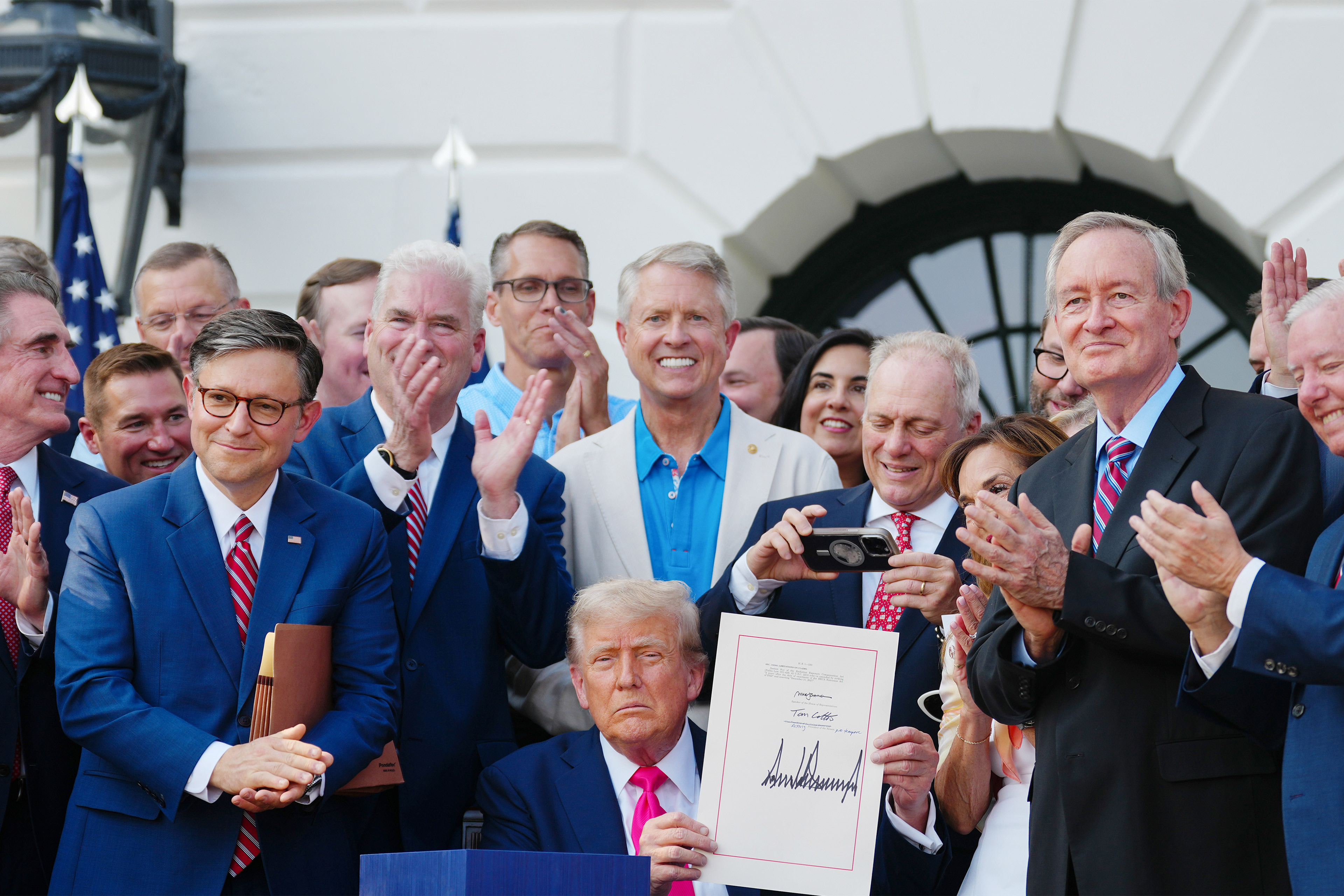
In July, President Donald Trump signed the “One Big Beautiful Bill Act,” which took aim at a subset of the provider tax that was perceived by the administration to be a loophole in federal rules.
The Big Beautiful Bill sought to cap state provider taxes at 6% in Fiscal Year 2027-28, before phasing the cap down to 3.5% in FY2031-32.
In September, the state House introduced House Bill 4968, which would have MDHHS request a waiver from the Centers for Medicare and Medicaid Services (CMS) to allow for continued collection and expenditure of that provider tax at current rates while the state prepares to implement required changes.
The bill passed through the legislature and went to Whitmer, who officially signed it last week along with the Fiscal Year 2025-26 budget. She held a public signing Monday.
Whitmer’s office said the state passed legislation to comply with the new federal regulatory landscape while preserving current revenue amounts and maintaining funding for health care providers statewide.
House Speaker Matt Hall, R-Richland Township, said the legislature was making smart reforms to protect Medicaid after Trump “took steps to stabilize Medicaid at the federal level.”
Senate Majority Leader Winnie Brinks, D-Grand Rapids, said the budget protects Medicaid from devastating federal cuts, “ensuring everyone is afforded the dignity of having access to care.
“With this bill, we are halting what was sure to be a catastrophic domino effect felt by all Michiganders, from kids, families, and seniors to health care workers and even to folks with private insurance,” Brinks said. “And by doing so, we have set ourselves apart as national leaders for the actions we’ve taken to safeguard Medicaid here in Michigan — and that’s certainly cause for celebration.”
Medicaid covers about 2.8 million residents, or 25% of the population, making it the state’s largest health insurer. In some rural counties, 40% or more of the population is covered by Medicaid.
Michigan is among the 40 states that have expanded Medicaid eligibility to adults with incomes up to 133% of the federal poverty line, according to the Citizens Research Council of Michigan. That’s an annual salary of about $20,345 for a family of one, or $35,444 for a family of three.
Whitmer said cuts of hundreds of billions of dollars to Medicaid would force providers in Michigan to close their doors, reduce the quality of services, and strip health insurance from millions of the most vulnerable Americans.
Federal changes to Medicaid included adding new work requirements.
Recipients who are able-bodied will be required to work at least 80 hours per month in order to continue to receive benefits, beginning in 2027. Exceptions exist for people 65 and older, parents with children younger than 14, pregnant women, and those “medically certified as physically or mentally unfit for employment.”
Amy Zaagman with the Protect MI Care Coalition called the bill signing a victory for every Michigander who believes quality, affordable health care should be within reach for all.
“By strengthening Medicaid and protecting the health coverage millions rely on, this legislation takes an important step toward making sure our state can continue to care for children, pregnant women, seniors, workers, and people with disabilities in every community,” Zaagman said.
The Michigan Association of Health Plans (MAHP), which represents private and employer-provided insurance providers, has called on the federal government to allow Michigan a three-year transition period to change its provider tax to avoid having to increase premiums on employers and employees.
“Commercial employer-sponsored health insurance is already facing unprecedented acuity claims and prescription drug costs, which are driving the cost of health insurance for employers and employees across the state,” said Dominick Pallone, MAHP’s executive director, in a statement. “Forcing the commercial market to subsidize even more of Michigan’s Medicaid costs through a new IPA will make health care less affordable for employers and working Michiganders.”
For more information on the federal health care program, visit Michigan’s Medicaid website here, or the national site at cms.gov.
The PA 25 health care tax fraud scheme allows Oregon to claim federal dollars for illegal immigrant health care. This is why Republicans started to wind down the tax fraud scheme in OBBBA The same tax fraud scheme is used to pay for illegals' health care in at least 11 other states, with California and New York racking up the largest (federally paid) subsidies. The cost increase of these programs is explosive. In Oregon, spending on its Medicaid expansion to immigrants regardless of legal status has increased from $ 100 million in FY 21 to $ 1.5 billion in FY 27.
Michigan seems content to pay for illegals' health care in hospital emergency departments with federal dollars, but has not developed a program comparable to Healthier Oregon. Michigan's hospital emergency department subsidy for illegals is carefully concealed from the public by state government, but probably cost taxpayers something between $ 300 million and $ 500 million per year:
Oregon Now Spends More On Program Offering Free Health Care For Illegal Immigrants Than State Police
By Emily Kopp - October 13, 2025
Investigative ReporterOregon will spend more in its current budget period on free health care for immigrants regardless of legal status than on state police by $500 million or more, according to state officials and budget documents.
Oregon officials expect to spend $1.5 billion in combined state and federal taxpayer dollars on a program that offers health benefits to illegal aliens from 2025 to 2027. They expect to spend $717 million on Oregon State Police over the same period, the documents indicate.
The state’s health agency, the Oregon Health Authority, said in an email to the Daily Caller News Foundation that the state expects to allocate $1.2 billion to the program — originally named “Cover All People” and now called the “Healthier Oregon Program” (HOP). Oregon lays out budgets in two-year “bienniums.”
The federal government will supply 25% of the funding to provide health benefits to illegal aliens in Oregon, the OHA told the DCNF.
The data emblematizes some of the Democratic stronghold’s policy priorities — facilitating illegal immigrants’ access to health care and reducing criminal crackdowns. These very policies have touched off a government shutdown in Washington, D.C., and protests in Portland.
Medicaid — the joint federal-state program that traditionally provided health services to children, pregnant mothers and disabled adults — formally bars illegal immigrants from receiving benefits.
But some blue states have innovated creative accounting methods to extract federal dollars without the federal restrictions, according to the Paragon Health Institute, a non-partisan policy research group. Blue states will issue taxes on Medicaid insurers and providers, obtain a bundle of federal matching dollars for those funds, then return the taxed money to those institutions, the think tank points out.
Spending on health services for illegal aliens in Oregon has climbed by at least 1100% since the program’s introduction roughly four years ago.
An Oregon report shows a steep jump in spending on its Medicaid expansion to immigrants regardless of legal status.
Lawmakers first introduced the program in 2021 with a $100 million cap. State Medicaid programs benefitted from increased federal matching dollars for the COVID-19 pandemic at that time. The proposal grew out of a racial justice council convened by then-Gov. Kate Brown in 2020 and enjoyed support from a coalition of managed care organizations, hospital groups, pro-abortion groups, medical professional societies, unions and advocacy groups.
In the intervening years, the national illegal immigration population surged under President Joe Biden, the public health emergency ended, and Oregon expanded eligibility to all age groups — causing the cost to balloon.
In October 2024, OHA faced a $260 million budget shortfall, according to the Lund Report, an Oregon-focused health news outlet. About 93,000 people had enrolled in the state’s Medicaid expansion for immigrants regardless of legal status, nearly double the state’s projection of 55,000 enrollees, the report said.
Showdowns In DC, Portland
The policy demands congressional Democrats in DC have named as a prerequisite for reopening the government include dismantling barriers preventing Medicaid dollars from flowing to illegal aliens.
Democrats’ counterproposal to the “clean” continuing resolution (CR) preferred by Republicans to end the government shutdown would unwind several reforms that President Donald Trump signed into law via the One Big Beautiful Bill Act (OBBB) in July.
These provisions included ending the disbursement of higher federal Medicaid match dollars for the emergency care of illegal aliens compared to traditional Medicaid recipients like children — states received a 90% rate for illegal aliens compared to 50% for American citizens — and closing accounting loopholes that allow federal funds to be shunted to state priorities like coverage for illegal immigrants.
Republican House Speaker Mike Johnson has estimated that the rollback of health reforms would cost roughly $192 billion.
In Oregon, an illegal alien need not supply proof of long-term residency in the state in order to receive the taxpayer-sponsored health benefits, according to state resources.
According to the OHA, the federal spending for Oregon’s illegal aliens only covers emergency and pregnancy care that the federal government is required to cover per U.S. law, echoing the arguments of Democratic leaders who say illegal immigrants cannot access federal Medicaid dollars outside of the emergency room.
However the OHA budget document shows the state will obtain federal dollars unfettered by federal rules through creative accounting too.
Oregon pads its state pot of Medicaid funds, funds unfettered by federal rules against dispersing it to illegal aliens, through what it describes as a “tax,” but what really amounts to an accounting loophole. Oregon “taxes” hospitals to obtain funding while tapping federal matching funds to pay back the hospitals the “taxed” amount in full.
Meanwhile in Portland, nightly protests continue outside of an Immigration and Customs Enforcement (ICE) facility.
Attorneys for the state of Oregon and city of Portland have argued in court against the deployment of the National Guard, saying that violent crime in Portland is significantly down.
But on Wednesday, the Portland City Council heard testimony from several small business owners who argued in support of an initiative to revive Portland storefronts amid break-ins, fires, graffiti, shoplifting, public drug use and visible mental health crises. (RELATED: ‘He Needs To Come Out Here’: Chief Border Patrol Agent Dares Dan Goldman To Walk Streets Of Chicago)
“I’ve replaced a total of nine windows, three locks from attempted break-ins, I’ve been spit on, I’ve been punched twice, once resulting in a black eye. I had a man masturbating in my window. I’ve had a gun pulled on me twice — once was last week. I’ve had a knife pulled on me,” said Steve Cook, owner of Portland business Vinyl Resting Place. “When I’m found dead in my shop, I’m gonna be like ‘I told you so.'”
Get MHF Insights
News and tips for your healthcare freedom.
We never spam you. One-step unsubscribe.
Sponsors

J & DE Family Charitable Fund

Friends
of MHF

Kelly Grotendiek
Philip Harbach
Dale Johnson
Drs. Jeffrey and Joni Jones
Vickie Kahle
Tammy Kipen
Marlin & Kathy Klumpp
Melanie Kurdys
Ruth Nobel
Patrick Peterson
Stephanie Poortenga
Jeanne Smit
Ben and Hope Staal
John Tuinstra
Jacki VanHuis
Sandy Walker
Sign Up for MHF Insights to keep up on the latest in Michigan Health Policy






