



Michigan healthcare freedom community forum

U.S. District Judge Indira Talwani in Boston was already overturned in her previous attempt to refund Planned Parenthood, so she is giving it another try in the latest lawsuit from the secret cabal of Democratic Attorneys General. AG Dana Nessel is a founding member of the cabal, so Judge Talwani's latest injunction will apply in Michigan, until it is also overturned:
US judge blocks Trump from cutting Medicaid funding for Planned Parenthood in 22 states
By Nate Raymond - December 2, 2025Summary
- Judge says 'impermissibly ambiguous' law boosts state costs
- Injunction covers 22 states that sued and Washington, D.C.
- Law ended U.S. Medicaid funds to large abortion providers
BOSTON, Dec 2 (Reuters) - A federal judge on Tuesday blocked U.S. President Donald Trump's administration from enforcing in 22 states a provision of the Republican's signature tax and domestic policy bill that would deprive Planned Parenthood and local affiliates that perform abortions of Medicaid funding.
U.S. District Judge Indira Talwani in Boston said a group of Democratic state attorneys general who had challenged the provision were likely to succeed in establishing that the law constitutes an unconstitutional retroactive condition on their participation in the Medicaid healthcare program.
Talwani called the law "impermissibly ambiguous," and said that allowing it to remain in effect would "increase the percentage of patients unable to receive birth control and preventive screenings, thereby prompting an increase in states’ healthcare costs."
The judge, who was appointed by Democratic President Barack Obama, issued a preliminary injunction, opens new tab that covers the 22 states that sued to challenge the provision led by California, Connecticut and New York, as well as the District of Columbia. But she put her ruling on hold for seven days to allow the Trump administration to appeal.
Talwani had previously blocked the law from being implemented on other grounds in a separate case by Planned Parenthood. A federal appeals court put that decision on hold in September while it weighed the administration's appeal.
A Planned Parenthood spokesperson in a statement hailed the ruling, saying Talwani "again recognized the 'defund' law for what it is: unconstitutional and dangerous."
The White House and the U.S. Department of Health and Human Services did not immediately respond to requests for comment.
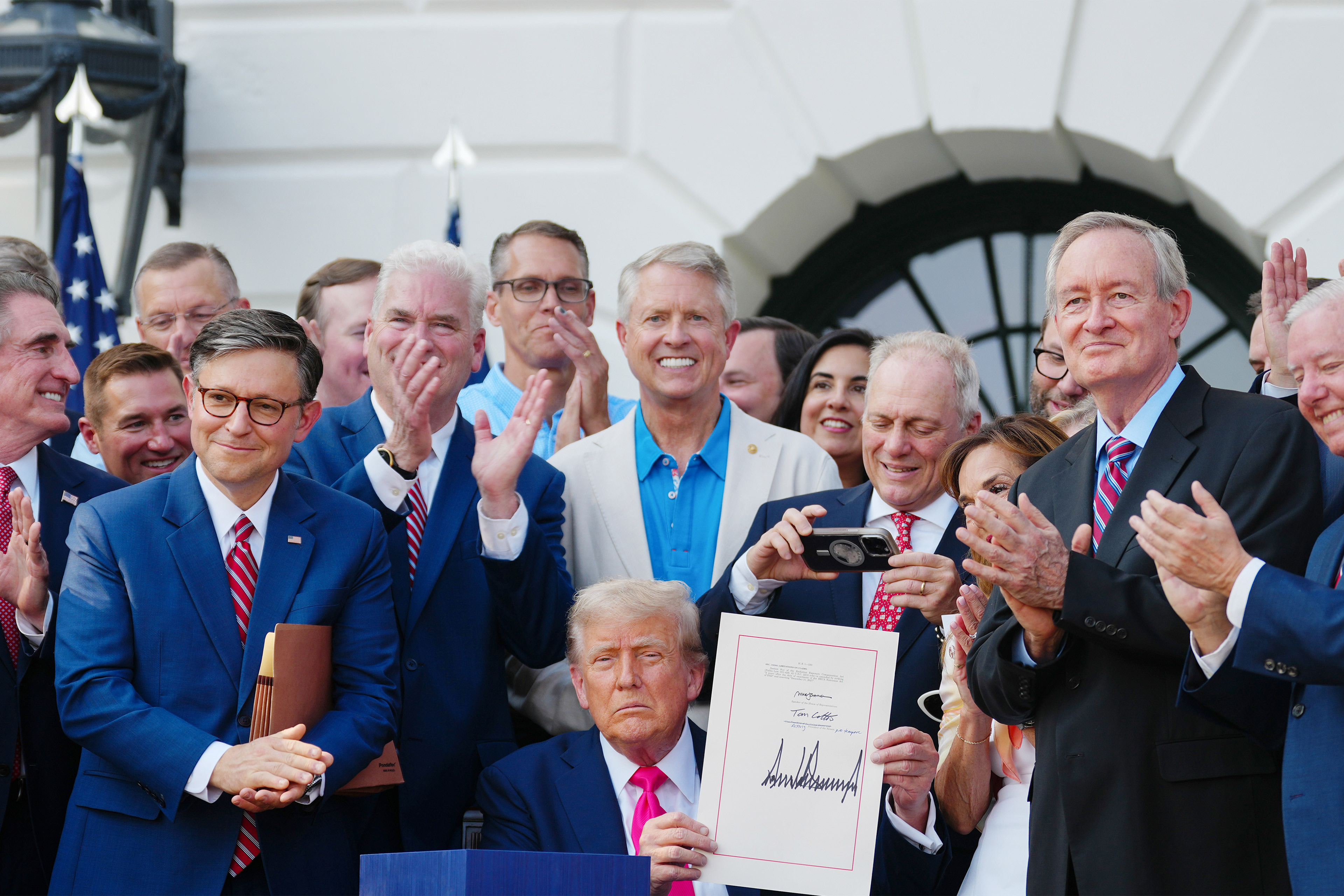
A provision in the One Big Beautiful Bill Act, passed by the Republican-led Congress, bars Medicaid funding for tax-exempt organizations that provide family planning and reproductive health services if they perform abortions and received more than $800,000 in Medicaid funds during the 2023 fiscal year.
Planned Parenthood says the law is already having devastating effects, noting that at least 20 health centers have closed since September, when the appeals court allowed the law to take effect.
The states had sued in July, arguing they were unprepared and ill-equipped to implement the law, which they said violated the U.S. Constitution’s Spending Clause by failing to provide states clear notice of which healthcare providers the defunding provision covered.
They said the provision constituted a change the states could not have anticipated when they joined the joint federal-state Medicaid program, which provides healthcare coverage to low-income Americans. States, not the federal government, have long been left to determine which providers qualify for the Medicaid program, the states said.
A three judge panel of the First Circuit Court of Appeals vacated Judge Talwani’s July orders granting preliminary injunctions blocking the defunding of Planned Parenthood:
https://storage.courtlistener.com/recap/gov.uscourts.mad.286600/gov.uscourts.mad.286600.98.0.pdf
Probably will take a few more months to overturn her December injunction blocking the defunding of Planned Parenthood.
Did not even take a month to overturn U.S. District Judge Indira Talwani's December (second) injunction blocking the defunding of Planned Parenthood. Talwani should be impeached and forced to run for political office to continue her legislative career:
https://thehill.com/policy/healthcare/5668686-planned-parenthood-funding-law/
Court allows Planned Parenthood Medicaid funding cuts in multiple states
by Ashleigh Fields - December 31, 2025A panel of federal judges on Tuesday lifted a ruling blocking Medicaid funding cuts for Planned Parenthood in multiple states.
The 1st U.S. Circuit Court of Appeals issued a hold on an order from District Judge Indira Talwani that had prevented a law removing funds from Planned Parenthood from being enforced.
The law in question was passed by Congress as part of President Trump’s tax package, commonly known as the “big, beautiful bill.”
That bill restricts Medicaid funding for tax-exempt organizations that provide reproductive services including abortions if they received more than $800,000 in Medicaid funds during fiscal 2023, according to Reuters.
Talwani’s injunction was previously being upheld in 22 states and Washington, D.C.
Planned Parenthood has warned the law could lead to the closure of its facilities.
“We are facing down the reality that nearly 200 health centers are at risk of closure. We’re facing a reality of the impact on shutting down almost half of abortion-providing health centers,” Alexis McGill Johnson, Planned Parenthood Federation of Americas’s CEO, said in a July interview with The Guardian.
“It does feel existential. Not just for Planned Parenthood, but for communities that are relying on access to this care,” McGill Johnson added.
We will post Michigan AG Dana Nessel's reaction to this reversal of Judge Talwani. Nessel joined her secret cabal of Democratic Attorneys General in this law suit.

Some administrative strategy insight.
https://www.dailysignal.com/2026/01/14/why-hhs-restored-planned-parenthood-funding/
Why Trump’s HHS Gave Planned Parenthood Tens of Millions in Funding Back
Elizabeth Troutman Mitchell | January 14, 2026
As some pro-lifers expressed outrage over the Trump administration restoring family planning funding to Planned Parenthood, other pro-life voices say there’s more to the move than meets the eye.
Politico reported that the American Civil Liberties Union on Monday dropped its lawsuit against the administration after the Department of Health and Human Services quietly released tens of millions in Title X family planning funds to Planned Parenthood and other clinics.
The move sparked widespread outrage from pro-life conservatives.
The ACLU, joined by The National Family Planning and Reproductive Health Association, had sued the administration over what they called “unlawful” withholding of more than $65 million in Title X grants to clinics.
But the agency may have had no choice but to restore funding, according to Tom McClusky, a veteran pro-life operative and director of government affairs at CatholicVote.
The agency withheld the funds before amending 42 U.S. Code Part 300, a rule which governs family planning grants.
“They were virtually certain to lose the lawsuit, forcing them to repay the full amount plus interest and cover attorneys’ fees,” McClusky told The Daily Signal.
“Even worse, continuing the litigation would have entangled any future funding cuts—which are highly likely under the new regulations—in prolonged court battles before an unsympathetic judge.”
A former senior Trump administration official told The Daily Signal the administration will now be in a better position to defund Planned Parenthood.
“HHS was caught in a tough spot because the judge was almost certainly going to rule against them and they would have had to restore the funding under Biden era rules, possibly with interest and attorneys fees on top for Planned Parenthood,” the former official said.
“With the case dismissed, the administration has far greater ability to cut Planned Parenthood funds under Trump era rules and that will be the true test of the president’s promise to end taxpayer funding of the abortion industry.”
However, McClusky said none of this would have happened if the administration had restored the Protect Life Rule, promulgated during the president’s first term and rescinded by the Biden administration.
That rule provided that a counselor in a Title X project could “neither refer for, nor encourage, abortion.” The second Trump administration has not reinstated it.
Ethics and Public Policy Center family policy scholar Patrick Brown said there have been examples of pro-life betrayals under the Trump administration, such as the lack of action on the abortion pill, but this move is not one of them.
If HHS hadn’t restored the funding, “Planned Parenthood would have had a much stronger legal case. And the concern there is, not only would they win this one, but it could make future litigation harder to to win,” Brown said.
Last March, HHS informed nine health care providers that it would withhold Title X funding due to “possible violations” of Trump’s executive orders, including one prohibiting groups receiving federal funding from having diversity, equity, and inclusion initiatives.
Planned Parenthood published a memo Nov. 12 saying that since the beginning of 2025, “nearly 50 Planned Parenthood health centers have been forced to close following the loss of Title X funds and Medicaid reimbursements.”
The “One Big, Beautiful Bill Act” removed Medicaid funding for Planned Parenthood.
Hannah Anderson, former deputy chief of staff for policy at HHS, said she is confident that the Trump administration will do “whatever they need to do, and can do to ensure that federal taxpayer dollars aren’t going to these clinics.”
“I think it is absolutely worth it for the federal government to say you have to play by the new rules on DEI and transgenderism, and they’ll either comply or not, and the courts will decide one way or the other,” Anderson, who is now senior director of policy at America First Policy Institute, told The Daily Signal. “But yes, we should be enforcing the rules equally on these facilities.”
The White House and Health and Human Services Department declined to comment for the story.
And the case is over. PP has thrown in the towel.
Planned Parenthood Ends Quest to Restore Half-Billion in Taxpayer Funding
Fred Lucas | February 02, 2026
In a significant legal win for the Trump administration and the pro-life movement, Planned Parenthood dropped its court case to restore federal funding through Medicaid.
Last year, President Donald Trump signed the “One Big, Beautiful Bill” that, among other things, defunded the nation’s largest abortion provider for a full year.
The defunding, though temporary, itself was a long-sought achievement for pro-life lawmakers.
“This is a tremendous victory for the pro-life movement, and the president will continue delivering on his promise to defend life and push pro-family policies,” White House spokeswoman Taylor Rogers told The Daily Signal.
In September, the 1st U.S. Circuit of Appeals ruled to allow the Trump administration to withhold Medicaid reimbursements to Planned Parenthood while the appeals proceed.
On Friday, the plaintiffs—Planned Parenthood Federation of America, and state affiliates in Massachusetts and Utah—dismissed their complaint.
“Planned Parenthood and others have spent months running to court to claw back more than half a billion dollars and subvert the will of the taxpayers, who strongly oppose being forced to fund the destruction of human lives,” Katie Daniel, director of legal affairs and policy counsel for Susan B. Anthony Pro-Life America, told The Daily Signal.
“Abortion businesses are not entitled by the Constitution to taxpayer dollars, and their efforts will not succeed.”
While a win for pro-life supporters, there are separate ongoing court cases involving Democrat-run states defending funding state Planned Parenthood clinics.
Further, unless Congress acts in an additional reconciliation bill, federal funding of Planned Parenthood will resume in July, noted Melanie Israel, visiting fellow at The Heritage Foundation.
“It’s a win for women, girls, and unborn babies when Planned Parenthood gives up its quest to force taxpayers to foot the bill for Big Abortion—over half a billion dollars per year, to be precise,” Israel told The Daily Signal. “We’ve known all along that nothing in the Constitution entitles Planned Parenthood to the American people’s hard-earned tax dollars.”
Pro-life groups have pushed for a full 10-year defunding provision before Planned Parenthood funding returns in July, she said.
“Denying big abortion its big payday doesn’t mean cutting funding for women’s health care generally,” Israel added. “Funding can still go toward real health care providers, including the thousands of Federally Qualified Health Centers and pregnancy resource centers that vastly outnumber Planned Parenthood clinics.”
Last year, the abortion group’s annual report covering the years 2023 through 2024 found it had more than $2.5 billion in net assets, with $792.2 million in government funding. During that time period, the group conducted 402,230 abortions, an increase from the previous annual report that showed 392,715 abortions.
Planned Parenthood has argued that federal dollars do not go to abortions at affiliate clinics, but rather to other women’s health care services. Critics have long noted that the money is fungible.
Planned Parenthood leaders have vowed to fight for funding on other fronts.
“President Trump and his allies in Congress have weaponized the federal government to target Planned Parenthood at the expense of patients—stripping people of the care they rely on,” Alexis McGill Johnson, president of Planned Parenthood Federation of America, said in a public statement.
“Through every attack, Planned Parenthood has never lost sight of its focus: ensuring patients can get the care they need from the provider they trust.”
This story was updated to include a comment from White House spokeswoman Taylor Rogers.
Planned Parenthood's OBBBA temporary funding cessation ends today:
https://thehill.com/policy/healthcare/5952223-planned-parenthood-regains-funding/
Planned Parenthood set to regain federal funding as GOP ban expires
By Nathaniel Weixel - July 2, 2026Planned Parenthood will regain access to federal funding on Saturday, one year after Republicans were able to cut its clinics off from Medicaid.
Last year, Republicans were successful in using the party-line One Big Beautiful Bill Act to achieve their long sought-after goal of defunding Planned Parenthood.
But the complicated Senate rules involved in passing the bill meant the ban only lasted one year instead of 10. Come July 4, Medicaid will once again cover non-abortion care at Planned Parenthood clinics nationwide.
Medicaid is prohibited from paying for almost all abortions under the longstanding Hyde Amendment, but conservatives sought to put Planned Parenthood and other clinics that provide abortions out of business by withholding all federal funding from those clinics. They argued women can receive the same non-abortion care elsewhere.
While the ban did not completely devastate the organization’s finances and drive it to financial ruin like many GOP lawmakers had hoped, Planned Parenthood clinics suffered.
“Tens of thousands of patients have been denied access to services like cancer screenings and birth control and STI testing and treatment. These are things that just can’t be undone,” said Nora Walsh-DeVries, vice president of political and legislative affairs at Planned Parenthood Action Fund.
The law forced the closure of 30 clinics, according to a new report from Planned Parenthood Action Fund and Planned Parenthood Federation of America.
In September 2025 alone, Planned Parenthood provided healthcare services at no cost to 100,000 Medicaid patients, covering an estimated $45 million in health costs.
Keeping that up was “deeply unsustainable” and not something every affiliate could manage, Walsh-DeVries said.
Roughly 11 states used state-only money to keep Planned Parenthood and other affected providers operational for their Medicaid enrollees over the past year. But that also was not something that could be sustained over a prolonged period.
Once the federal ban lifts, those states will be able to receive federal Medicaid matching funds and won’t need to use their general funds to backfill lost federal revenue.
All health center closures were in “contraceptive deserts” — counties where there are too few healthcare providers offering the full range of methods to women eligible for publicly funded birth control.
As a result, there were significant drops in packs of birth control pills being dispensed, as well in the number of women who visited for IUDs and other long-acting contraception.
Two-thirds of health center closures occurred in either rural areas, medically underserved areas, or areas experiencing shortages of primary care professionals.
“I think it’s just really clear that patients have totally borne the cost of this politically motivated attack on care, and unfortunately, that’s happening disproportionately in these rural areas where there isn’t necessarily any alternative,” Walsh-DeVries said.
Before “defunding” took effect, around half of all visits to Planned Parenthood health centers were from patients who relied on Medicaid. Visits from Medicaid patients dropped by 25 percent compared to the same period during the previous year.
Still, the impact was predicted to be worse.
Just after President Trump signed the One Big Beautiful Bill Act into law, Planned Parenthood Federation of America president and CEO Alexis McGill Johnson said nearly 200 health centers in 24 states were at risk of closing.
Anti-abortion groups weren’t satisfied with the one-year ban and have been pressuring lawmakers to extend the provision. While it won’t happen before the July 4 deadline, they are pushing GOP leaders to include it in a third reconciliation bill that they want to pass before the end of the year.
Last year, they warned lawmakers against creating a cliff just ahead of the midterms. They now worry that Republicans are squandering their control of government and won’t get another shot to pass conservative priorities if Congress is split after November.
“Defunding Big Abortion is now the default expectation of the pro-life movement. When they return to D.C., Republicans must do all they can through reconciliation to once again block taxpayer dollars from Planned Parenthood and abortion businesses,” Susan B. Anthony Pro-Life America president Marjorie Dannenfelser said in a July 1 statement.
Speaker Mike Johnson (R-La.) wants to start working on a third reconciliation bill soon, and hard-line conservatives of the House Freedom Caucus are demanding an extension of the Planned Parenthood defunding provision.
But Senate Republicans are cooler to the idea of a third reconciliation bill, and don’t think it’s realistic given the narrow margins Republicans hold and the general reluctance of some lawmakers to start an abortion fight so close to the midterms.
Polling has shown that a majority of voters oppose defunding Planned Parenthood. Last year, the defunding provision faced opposition from vulnerable Republicans in both chambers, even though almost all ultimately voted for it.
Even when the provision expires and Medicaid funding is restored, Walsh-DeVries said there’s no clear framework for how Planned Parenthood affiliates can obtain that money. In addition, she said she expects some states will continue the ban on their own and will cut off Planned Parenthood from Medicaid reimbursements.
The Supreme Court last year said states are allowed to exclude providers from their Medicaid programs, and Medicaid enrollees can’t challenge those exclusions in court.
According to an analysis from Laurie Sobel, an associate director with KFF’s Women’s Health Policy Program, 13 states have either blocked or tried to block Medicaid reimbursements to Planned Parenthood.
Other states “may follow suit” once the nationwide Medicaid prohibition expires July 4, Sobel wrote.
Get MHF Insights
News and tips for your healthcare freedom.
We never spam you. One-step unsubscribe.
Sponsors

J & DE Family Charitable Fund

Friends
of MHF

Kelly Grotendiek
Philip Harbach
Dale Johnson
Drs. Jeffrey and Joni Jones
Vickie Kahle
Tammy Kipen
Marlin & Kathy Klumpp
Melanie Kurdys
Ruth Nobel
Patrick Peterson
Stephanie Poortenga
Jeanne Smit
Ben and Hope Staal
John Tuinstra
Jacki VanHuis
Sandy Walker
Sign Up for MHF Insights to keep up on the latest in Michigan Health Policy